Hanover Conservancy

Facebook logo   Instagram   YouTube          
Donate button
  • Home
  • About Us
    • Celebrating 60 Years
    • What We Do
      • Advocacy
      • Conservation
      • Education
      • Stewardship
    • Board & Staff
    • Membership Benefits
    • Contact Us
  • Get Outdoors
    • Hanover Lands
      • Balch Hill Natural Area
      • Mink Brook Nature Preserve
      • Other Properties
    • Hanover Hikes
    • Hanover Trails Challenge
    • Upper Valley Hikes
    • Exploring Nature at Home
    • Hunting
  • Events
    • Calendar
    • Spring Wildflower Scavenger Hunt
    • Private Events
  • Get Involved
    • Donate
    • Volunteer
    • Adopt a Trail
    • Corporate Conservators
    • Planned Giving
  • Education
    • School Programs
      • KAST
      • Connecticut River Studies
      • Hanover High School Scholarship
    • Request a Field Trip or Speaker
    • Research on Our Lands
    • Hanover History
    • Resources
  • News
    • Remembering Bob Norman
    • Reports & e-News
  • Conserve Your Land

Hanover Trail Maps available at Town Offices

May 28, 2020

In a message sent by the Town on 5/28/2020: Back by popular demand, the 2013 Hanover Trail Map has been re-printed and is available for purchase at the Town Offices, 41 South Main Street.
The price will vary depending upon your method of payment and whether you would like the map mailed to you.

If you come to the Town Offices,  the map costs:
$7 if you pay by check; or
$8.50 if you pay using a credit card.

If you would like a map mailed to you,  the map plus postage costs:
$8 if you pay by check; or
$9.50 if you pay using a credit card.

The map is also available on the Town website (for free) https://www.hanovernh.org/conservation-commission/pages/trail-maps

Get out and enjoy our wonderful trail system!

Vicki Smith
Senior Planner
Planning and Zoning Department
PO Box 483
41 South Main Street
Hanover, NH 03755

603-640-3214

Filed Under: Education, Partnerships, Trails

Hot off the press!

September 1, 2019

We’re excited to be featured in the fall issue of Here in Hanover magazine! Pick up your copy around town or share the article with friends online.
hih

Filed Under: Education, Media, Partnerships

NHPR Features Wilder Dam Relicensing Project

June 2, 2018

For Residents On The Connecticut River, Hydro Dams’ Relicensing Is A Rare Opportunity

Whitewater rushes out of Wilder Dam, near Hanover, in early May.

Whitewater rushes out of Wilder Dam, near Hanover, in early May.
BRITTA GREENE FOR NHPR

Read more or listen to the segment here.

Filed Under: Education, Media, Wilder Dam

TRESCOTT LANDS OPEN!

December 12, 2016

As of Dec. 15, the Trescott Water Supply Lands are open for public recreation. Please help keep this beautiful area open for all to enjoy, by observing simple rules that protect our community’s drinking water quality. MORE

When you shop at smile.amazon.com, we hope you’ll consider designating the Hanover Conservancy to receive a donation of 0.5% of your purchase – at no cost to you. ‘Tis the season!

2017 Winter Trips – our colorful trip card will arrive in current members’ mailboxes right after Christmas. Look for yours!

Filed Under: Education, Forest Ecology, Hunting, Lands, Partnerships, Stewardship, Trails, Trescott, Volunteers, Wildlife

Trescott Lands CLOSED!

September 26, 2016

Due to ongoing problems with recreation that compromise our public water supply, the Trescott Lands are closed for all purposes except hunting until further notice.

More details here…

Next event – The Messenger – Sat., Nov. 5, 11am

Filed Under: Deer, Education, Hunting, Partnerships, Trails, Trescott

Protection of Natural Habitat in the Route 120 Corridor

February 14, 2009

Rt. 120 – Mount Support

Route 120 Corridor
Route 120 Corridor

PROTECTION OF NATURAL HABITAT in the Route 120 Corridor

The Route 120 Corridor in Lebanon and Hanover contains some astounding beauty and ruggedness, with habitats harboring an exceptional richness of wildlife.

Although commercial and residential developments are prevalent along the major roadways (Rt. 120, Greensboro Road and Great Hollow Road), the interior contains more than 500 acres of contiguous forest with diverse habitats and natural features.  It is truly a unique landscape worthy of protection.

With further development slated for this growing area, many residents attended public meetings in 2007 and 2008 to expressed their desire to protect the “wild” areas in this corridor.  Both Lebanon and Hanover residents voiced their support for this ecologically and geologically diverse area, and their commitment to maintaining its environmental quality.

We recognize the ecological value of the 120 Corridor, and strongly agree with the many residents committed to its protection.  The Hanover Conservancy envisions the permanent conservation of this relatively wild core interior area with its diverse flora and fauna, fragile wetlands, critical wildlife corridors, and distinctive geological features.   To that end, we have begun working to forge partnerships, facilitate discussions, and begin the necessary steps to make this happen for the future of our communities.

This is a unique opportunity for our two communities to work together to maintain the integrity of this special wilderness.  Bears, birds and other wildlife have no concern for town boundaries as they move about the forest.   Let us not limit our conservation actions by some line on a map.

THE LAND

It is remarkable that, so close to our town centers, there are lands with qualities we generally associate with much more extensive and remote wilderness. Fortunately, the ruggedness of these areas and long-term stable ownership have protected them from major disturbances in the past.

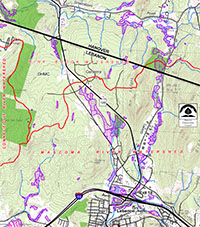
The core habitat areas of the 120 Corridor are bordered by three major roads:  Rte 120, Greensboro Road and Great Hollow Road (see map).  The northern part of the 120 Corridor drains to Mink Brook, the southern part to the Mascoma River, and both of these flow to the Connecticut River.  This large interior forested area includes Mt. Support, Rix Ledges, many wetlands that support rare species and plant community types on a diverse terrain of large boulders and outcrops.

A network of adjacent conservation lands provides travel corridors for wildlife, and increase the conservation value of the Route 120 Corridor.  These neighboring conservation lands include the Appalachian Trail, Mink Brook Nature Preserve, Greensboro Ridge Natural Area, Hypertherm Wetlands and Great Hollow Forest in Hanover, and Indian Ridge, the Landmark Tract, and Boston Lot Lake in Lebanon.

A. THE CASE FOR LAND PROTECTION:

Multiple reports (e.g., Lebanon’s Natural Resource Inventory, and work by The Nature Conservancy and NH Fish and Game) document the many wetland areas, small streams, rich deciduous forests, high quality wildlife habitat, rare plants and unusual rock formations in the Rt. 120 corridor.  Noteworthy features include:

  • Quality habitat and populations of bear, moose, bobcat and other mammals, characteristic of wilderness areas in New England
  • Exemplary bog and acidic seepage swamp habitats
  • Barrens strawberry -included on the state’s list of threatened plants
  • Stream edges include hemlock talus forests and mixed hardwood deciduous forests
  • Extensive forested wetlands with streams flowing north to Mink Brook
  • Glacial erratics, boulder fields, ridges, rock faces and amphitheaters
  • Extensive bands of maidenhair fern, rattlesnake plantain and cathedral pines.
  • Examples of near-old-growth trees

Furthermore, the 2008 NH Fish and Game Department report emphasizes that land conservation efforts are critical for the significant wildlife movement that takes place in the corridor.

B. CONSERVATION PRIORITIES

The Conservancy believes that community plans must protect core natural areas, and separate these undisturbed natural areas from commercial and residential developments with adequate buffer zones.  We encourage the use of  “smart growth” principles which concentrate buildings near existing infrastructure and conserve open lands and access routes that minimize environmental damage.  Project planning must consider these objectives.

  • Core natural habitat in the 120 Corridor must be protected from disturbance and increased development. Preserve existing wildlife corridors in the interior and create new ones across roads and developed areas.
  • Buffer streams to protect water quality.
  • Protect Mount Support and Rix Ledges. These are important examples of geologically uplifted lands with very dramatic topography. This accentuates their remote, wild character.
  • Any public access trails should be kept at a minimum and be near developments, avoiding the most sensitive lands.

C. CURRENT STATUS

The City of Lebanon has now granted approval for Phase I of development on 15 acres at the former Wilson Tire site. Conservation of lands on the Lebanon side is included in plans for a later phase that is currently contingent upon further approvals and an inter-municipal agreement to address sewerage treatment.  On the Hanover side, discussions have not yet advanced.

CONCLUSION

It is essential to develop an overarching plan for future developments in the 120 Corridor. We need to think beyond our human town boundaries and avoid piecemeal development approvals to define the overall character of this unique area. The Hanover Conservancy supports the conservation of this large, core natural area while development moves forward under smart growth principles.

Filed Under: Conservation, Education, Forest Ecology, Route 120 Corridor

  • « Previous Page
  • 1
  • 2

71 Lyme Road
Hanover, NH 03755
(603) 643-3433

info@hanoverconservancy.org

Facebook logo   Instagram   YouTube

Get Involved

Become a Member

Volunteer

Business Sponsors

Conserve Your Land

Employment

Our Mission

Advocacy

Conservation

Education

Stewardship

Explore Hanover

Hanover Hikes

Upcoming Events

Upper Valley Hikes

Trails Challenge

Copyright © 2025 Hanover Conservancy | Design by Chase Brook Software