Bioengineering at Mink Brook
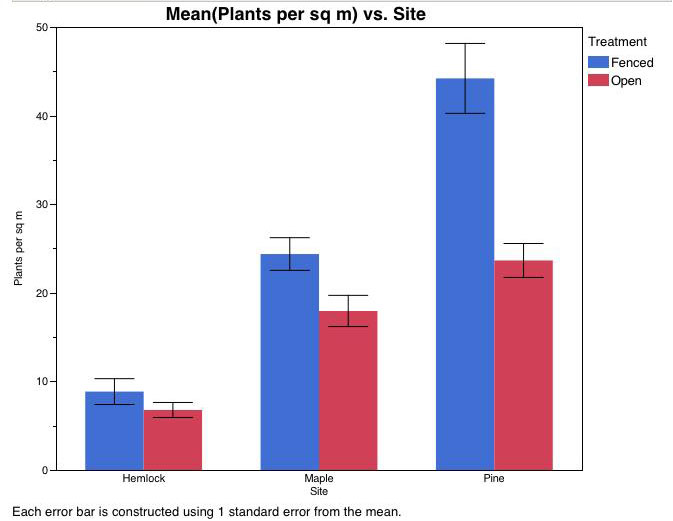 Just how much do deer affect vegetation at Balch Hill? To find out, we are working with Dartmouth Professor Craig Layne and students in his Ecological Methods class on a long-term experiment at the Natural Area. In 2012, we erected a number of fenced “exclosures” to foil hungry deer. Here are the results – after just one year, the number of plants in the fenced areas (shown in blue) were almost twice the number in places (shown in red) where deer could get at them. Stay tuned for updates.
Just how much do deer affect vegetation at Balch Hill? To find out, we are working with Dartmouth Professor Craig Layne and students in his Ecological Methods class on a long-term experiment at the Natural Area. In 2012, we erected a number of fenced “exclosures” to foil hungry deer. Here are the results – after just one year, the number of plants in the fenced areas (shown in blue) were almost twice the number in places (shown in red) where deer could get at them. Stay tuned for updates.
After three years’ work to control invasive buckthorn, honeysuckle, barberry, and Japanese knotweed that had overrun the floodplain at Mink Brook, we replanted with 2000 native trees and shrubs. The species selected are well-adapted to water level changes and offer excellent food and cover for birds and other wildlife. Silver and red maple, red osier dogwood and elderberry, and others will occupy the space formerly taken by invasives. For a few years, they’ll remain protected by mesh sleeves against the efforts of hungry beavers and deer.
Thanks to our volunteers, including the Hanover Lions Club, who worked alongside our forester, Ehrhard Frost of Full Circle Forestry, and his crew. The project is supported by a cost-share grant from the USDA Natural Resources Conservation Service and a generous gift from the Hanover Lions Club. Thanks also to Hanover/Norwich Youth in Action for checking on the plantings, pulling garlic mustard, and improving trail surfaces.
As part of an on-going project with the USDA Natural Resource Conservation Service, the Hanover Conservancy has conducted a treatment to control invasive Japanese Knotweed along the corridor of Mink Brook in the Mink Brook Nature Preserve. A special permit has been issued for this work, carried out by a licensed professional under the supervision of our eco-forester, Ehrhard Frost. Our project is funded by the USDA Natural Resources Conservation Service.
Aggressive non-native plants like Japanese knotweed, honeysuckle, bittersweet, and glossy buckthorn steal habitat from native plants and wildlife. We are in the middle of a three-year project to control them.
In the spring of 2012, we began the next phase of this project, replanting with 2000 native trees and shrubs that are well-adapted to growing conditions at Mink Brook Nature Preserve.
Dartmouth College is Hanover’s largest landowner and most significant local conservation partner, whether we look at acres or number of parcels preserved, neighbors benefited, or miles of trail protected.
The College’s major contributions to Hanover Conservancy properties have been to the Balch Hill Natural Area, where Dartmouth owns undeveloped land east of the summit and welcomes public access, and especially to the Mink Brook Nature Preserve. Dartmouth’s role at Mink Brook was not known to the public until recently. It was Dartmouth’s (then anonymous) substantial financial gift that made the conservation of the 112 acre Mink Brook parcel possible.
At our 50th Annual Meeting in December, 2011, President Nancy Collier presented retiring Dartmouth Director of Real Estate Paul Olsen, and Director of Campus Planning Joanna Whitcomb, with a framed photograph of Mink Brook embellished with a chronology of Dartmouth’s conservation achievements since 1960. The list includes conservation easements, donations, support for protective re-zoning, and property transfers, affecting over 2800 acres.
An article about the Hanover Conservancy’s relationship with the College appeared in Dartmouth>Now shortly afterward.