Hanover Conservancy

Facebook logo   Instagram   YouTube          
Donate button
  • Home
  • About Us
    • Celebrating 60 Years
    • What We Do
      • Advocacy
      • Conservation
      • Education
      • Stewardship
    • Board & Staff
    • Membership Benefits
    • Contact Us
  • Get Outdoors
    • Hanover Lands
      • Balch Hill Natural Area
      • Mink Brook Nature Preserve
      • Other Properties
    • Hanover Hikes
    • Hanover Trails Challenge
    • Upper Valley Hikes
    • Exploring Nature at Home
    • Hunting
  • Events
    • Calendar
    • Spring Wildflower Scavenger Hunt
    • Private Events
  • Get Involved
    • Donate
    • Volunteer
    • Adopt a Trail
    • Corporate Conservators
    • Planned Giving
  • Education
    • School Programs
      • KAST
      • Connecticut River Studies
      • Hanover High School Scholarship
    • Request a Field Trip or Speaker
    • Research on Our Lands
    • Hanover History
    • Resources
  • News
    • Remembering Bob Norman
    • Reports & e-News
  • Conserve Your Land

Headwaters Forest Spring Loop

May 1, 2025

Driving directions:

  • From Etna Village, take Ruddsboro Rd for 1.5 miles to Three Mile Rd.
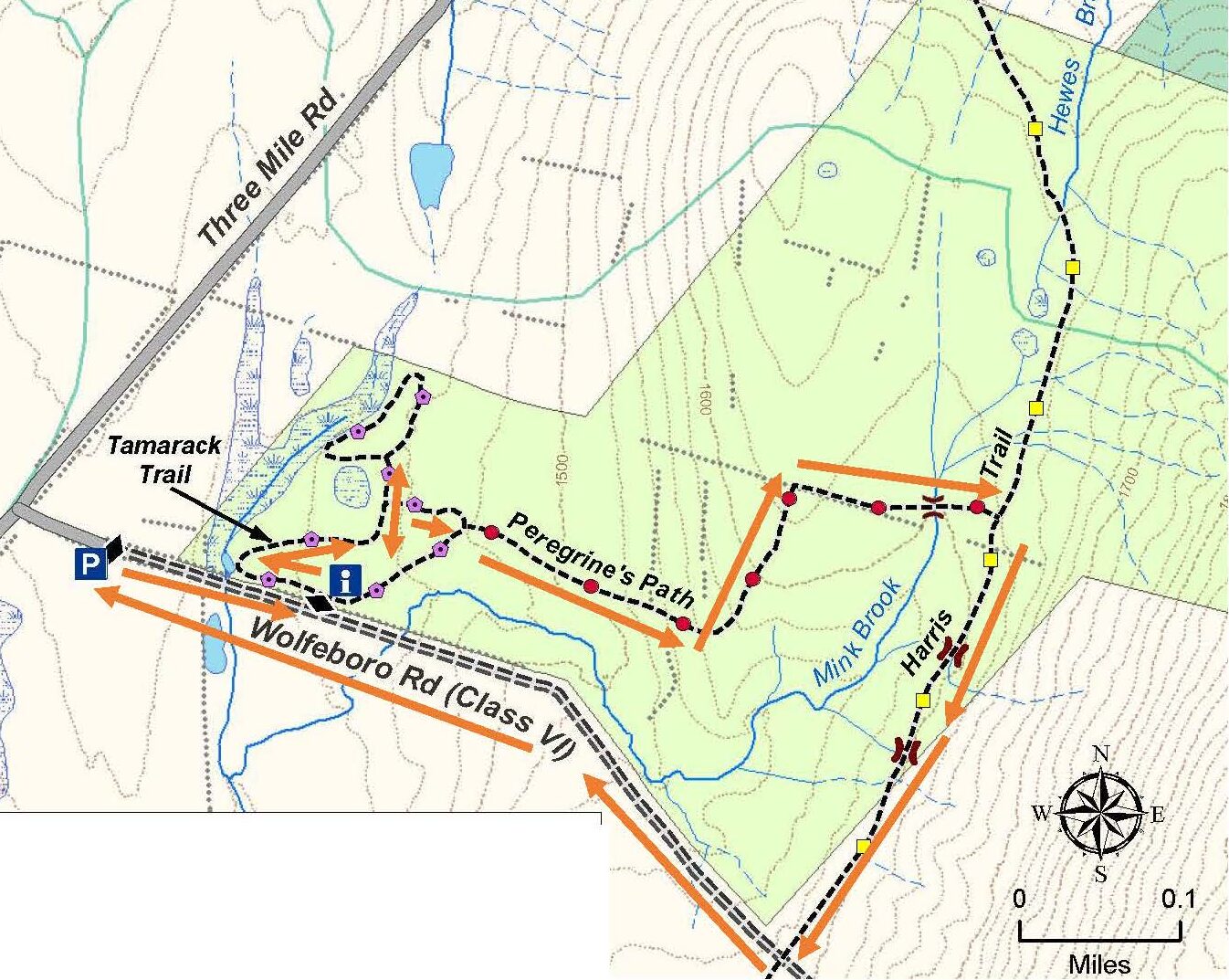
  • Turn left and proceed for 1.8 miles. Turn right onto the Wolfeboro Rd and park on right before red gate.
  • Please park courteously and do not block gate or private drives. Try not to run over clumps of red trillium!

What you should know:

  • Leave no trace — please carry out your own trash
  • Trails are open for foot travel at all seasons
  • Please pick up after your pet; dogs must be under the direct control of their owners
  • No camping or fires
  • Hunting is permitted in season
  • Leave wildflowers, fungi, and wildlife undisturbed
  • The 140-acre Headwaters Forest on Moose Mountain is owned and managed by the Hanover Conservancy.

Headwaters Forest Spring Loop – Full PDF


BRIEF HIKING DIRECTIONS

  • Begin at the red gate and walk east on the Wolfeboro Road to a gray metal gate at left
  • Visit the kiosk before taking the Tamarack Trail left to the frog pond
  • Skirt the wooded wetland to a far corner of the meadow marked by birches
  • Turn left and follow a boardwalk to a secluded meadow
  • Retrace your steps to the main meadow and walk uphill to the opening in the woods marked Peregrine’s Path
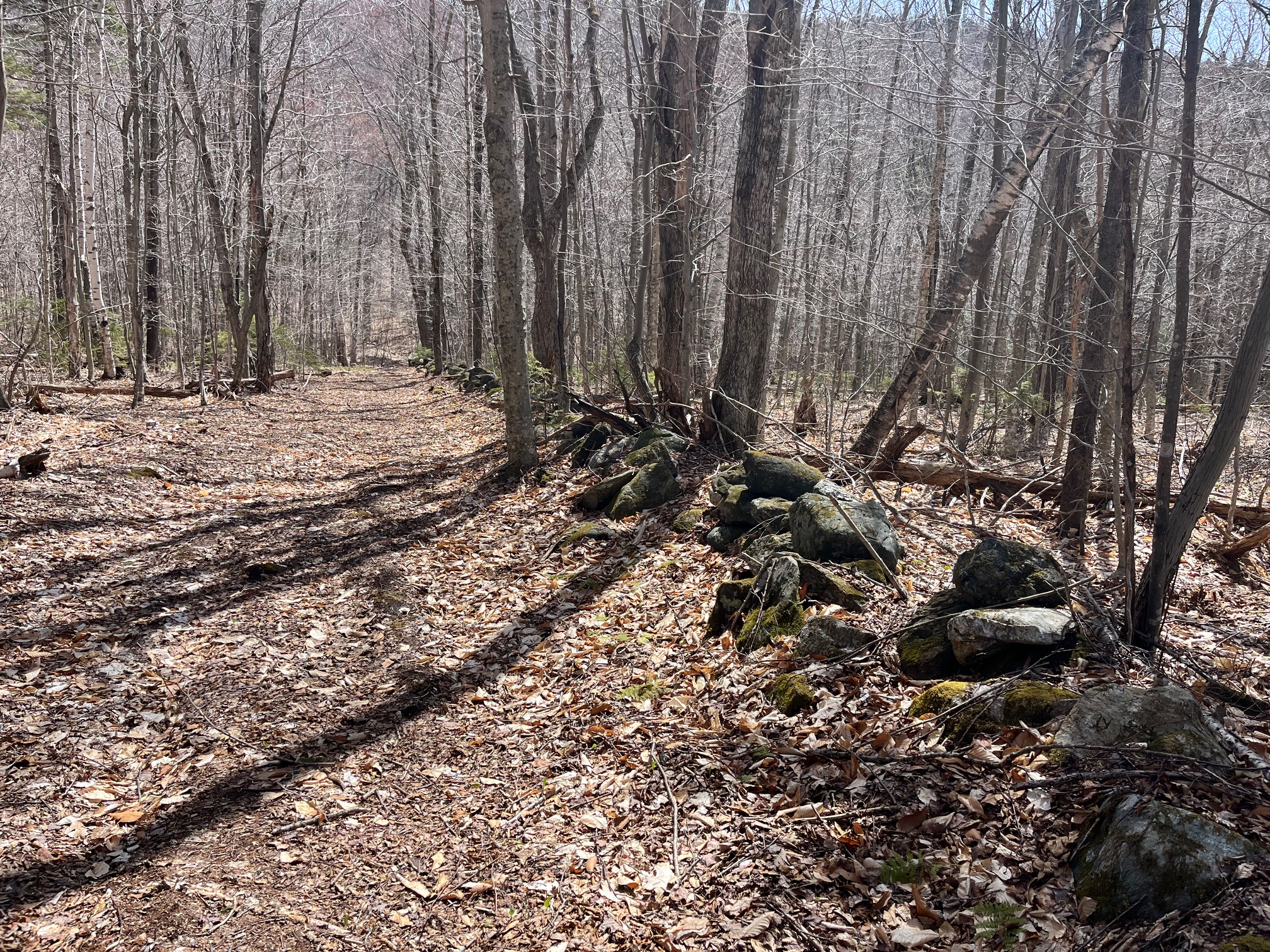
  • Follow Peregrine’s Path up through the forest to a stone wall-lined sheep lane
  • Turn right, following the lane, cross Mink Brook on a small footbridge, and continue to the Harris Trail
  • Turn right onto the Harris Trail and follow it to the Wolfeboro Road
  • Turn right onto the Wolfeboro Road and walk down the slope to return to your car

FULL DIRECTIONS

  • Begin your hike at the red gate marking the historic Wolfeboro Road’s change from Class V to Class VI.
  • A few minutes’ walk brings you to a grey metal gate across a gap in the road-side stone wall at left. Walk around the gate to visit the trailhead kiosk. You’ll find a map and trail guide in the dispenser along with a
    grateful acknowledgment of all those friends, families, and organizations who helped the Hanover Conservancy purchase and protect this land in 2023.
  • Take a moment to inspect the antique cultivator parked beneath the kiosk. It speaks volumes about the hard work involved in farming this land in years past. Not long after the Wolfeboro Road was cut over Moose
    Mountain to Three Mile Road in 1772, a farm family set up at the junction and began clearing the slope behind you, first for a subsistence farm. Later came sheep, then cattle. The last to farm this land was Dick
    Kendall and his family, from whom the Conservancy purchased his 150 acres.
  • Turn left on the Tamarack Trail to visit the little frog pond at the base of the slope. Look for egg masses and hope for a visit from the handsome pair of mallards who greeted us the day we visited. Beyond, the red farmhouse rests on the site of the original late 18th century cape, rebuilt by Dick Kendall 60 years ago.
  • Facing the pond, note the tall stand of tamaracks gathered around a single pine off to your right, and make a point of visiting again in late fall to catch them in their golden
    glory. In early May, bundles of bright green needles are just erupting from the trees’ glowing russet twigs. Tamaracks, also known as larch or hackmatack, are our only
    native deciduous conifer.
  • Head toward them, following the curve of the wetland edge. At this season, a variety of willows showing off their yellow twigs and others with fluffy green foxtail-shaped
    inflorescences dominate the scene. Willows love wet feet, as do speckled alders, whose unlikely-looking fat cones top each branch. (If you don’t appreciate wet feet,
    admire these wetland dwellers from a distance). Shrubby wetlands like this offer great cover for a variety of wildlife while storing water from heavy storms to release it slowly downstream – in this case, to Mink Brook.
  • Follow the wetland edge to the right and gradually uphill through the moist meadow. At this season, “camo”
    colored trout lily leaves underfoot seem out of place but are curiously thriving. In high summer, this is a great
    place for lowbush blueberries.
  • Climb the far side of the meadow opposite the kiosk to a gathering of graceful white-barked birches and popples. Turning left around this corner reveals a wooded passageway marked by a bog bridge. Here, the antique cultivator rested for years – keeping a 1960s VW bus company (now reincarnated elsewhere). At right, a yellow sign indicates the continuation of the Tamarack Trail. Follow the boardwalk north, thanking a grant from Mascoma Savings Bank for the lumber keeping your feet dry.
  • The boardwalk invites you to visit a beautiful secluded meadow. Near the middle is a pile of stones, left by a long-ago farmer who had picked the rock out of his fields and moved them here on a stoneboat (a low wooden sled) with the help of his horse, but never got around to using them in a stone wall.
  • Years ago, the wooded wetland before you was an open beaver pond where the Kendall children learned to skate. The beavers eventually ate themselves out of house and home, and moved on. In their absence, birch and popple returned.
  • Return via the boardwalk to the larger meadow and turn left up the hill. As you approach an opening in the woods ahead, pass a cluster of old apple trees on your left. Every farm once had an orchard, not only for fruit to eat and cook, but also for apple cider vinegar, a useful preservative.
  • Find the entrance to Peregrine’s Path, which follows an old woods road into the forest. The family of
    Peregrine Spiegel, who often hiked and skied this path, was instrumental in helping the Conservancy protect
    this land after the passing of its owner. The path is marked with cranberry blazes.
  • Soon after leaving the meadow, note a group of honeysuckle bushes at left, marked with orange tape. This property has suffered only slightly from invasive plants such as these, but it’s not surprising to find them along what was a log-hauling road. They are on the list to be removed so they cannot spread further.
  • Pass through a log landing and an area of close-growing small trees. This new forest was the last area where Kendall cut firewood to heat his home, and it is now growing back. Beyond, white birch represents a slightly later stage of this early successional forest.
  • Continue on as the old woods road climbs gently up and bears left on the last bit of uphill walking today.
  • Just after this turn, be on the lookout for handsome patches of our three most common clubmosses, beginning with ground pine on the left, followed on the right by the well-named erect shining clubmoss and then ground cedar with its flattened, scale-like leaves. These ancient plants spread along the forest floor by creeping rhizomes.
  • About 10 minutes after leaving the meadow, you arrive at a surprising sight – a bob house in the middle of the woods! What is an ice-fishing shack doing here? After
    spending time on Post Pond and other more conventional places, it took up duty as a place for Dick Kendall to store his chainsaw and get out of the rain. The Conservancy
    is hoping to retrofit it for a new role. The opening visible at right is the former site of Dick Kendall’s portable sawmill operation. Here’s a good glimpse of the Moose
    Mountain ridge above.
  • Continue on Peregrine’s Path, passing left of the bob house on the straight, flat trail. In a few minutes you’ll arrive at a large red maple, double-blazed to indicate a turn at a stone wall. A flat stone at its base invites you to sit for a drink and snack. Healthy outdoor recreation in a natural place like this is one reason why the Moose Plate program made a grant to the Hanover Conservancy to
    help protect this land.
  • While you’re there, gaze up amid the bare branches to admire the maple’s lesser known showy season – its tiny yet brilliant red flowers, which can make quite a splash
    against a bluebird sky. Sugar maples have yellowish-green flowers. Both are wind pollinated and typically have separate male and female flowers on different branches.
  • After admiring the flower show overhead, look down at your feet for an eye-catching boulder of quartzite. Moose Mountain features many quartzite intrusions. The milky white
    stone gleams on the sunny forest floor in early spring before foliage emerges to shade it. The tiny single green lily-like leaves at your feet are Canada mayflower.
  • Before continuing, look back at the crowded young forest you’re leaving behind as you turn right onto the old sheep lane and into an older forest where competition has thinned out the trees over time. From the 1820s until the Civil War, the Sheep Craze took hold in the Upper Valley, and Moose Mountain’s slopes were cleared up to about the 1700’ elevation to provide pasture for them. In 1840, over 11,000 sheep grazed in Hanover. As the wool textile industry moved south, farmers abandoned their most distant pastures and the forest returned, with older forests on pastures abandoned the longest. We see the signature of that here.
  • Follow the stone wall down the sheep lane, alert for a few remaining stubs of young trees that had been cleared from the path. In six minutes, reach a tiny valley where the wall ends at a large angular boulder with an embedded intrusion of white stone. What sort of animal does it remind you of?
  • Arrive at a new footbridge, built by the Conservancy in 2024 with the help of the Upper Valley Trails Alliance High School Trail Crew to protect nascent Mink Brook. The tiny stream’s waters are clear and cold, a sign they are well protected by the undisturbed forest and will provide good rearing habitat for young brook trout downstream. This is one reason the Greater Upper Valley Chapter of Trout Unlimited provided a grant to help build this bridge. Young red spruce, important for ruffed grouse, cluster nearby.
  • Cross the bridge and follow the new red-blazed, winding path back out of the little valley past stands of trout lilies into a mature, open forest of glistening yellow birch, maples, ash, and beech.
  • A few minutes’ walk from the bridge, arrive at the Harris Trail, which runs north-south along the contour, halfway up the mountain ridge. The original route of the Appalachian Trail, built in the 1920s, the Harris Trail is a favorite with backcountry skiers and hikers. It runs from Moose Mountain Lodge Road north to Goose Pond Road. The longest single section is across the Headwaters Forest.
  • Note the trio of gray-barked beech trees on the far side of the Harris Trail. Two, including the one marked with pink flagging, display the pitted and scarred bark of trees suffering from beech bark disease. The largest, however, has completely smooth, healthy bark and appears to be genetically resistant to the disfiguring disease. Moreover, its sturdy stem exhibits curious wrinkles that resemble an elephant’s leg. We’ve consulted many experts, and the only explanation offered is that the tree must have responded to strong winds at one time.
  • Turn right on the blue-blazed Harris Trail and head south through a gap in a stone wall. At this season, before the understory leafs out, you can see far up the hillside on your left to a line of ledges that could offer good bobcat denning. Bobcats share the forest with other wide-ranging wildlife like moose, deer, black bear, coyote, and other smaller mammals. Connecting this forest with the protected Appalachian Trail corridor and the Conservancy’s own Mayor-Niles and Britton Forests is one reason why the Land and Community Heritage Investment program made a major grant to the Hanover Conservancy to help protect this land.
  • As you walk this wide, flat trail, keep an eye out for the evergreen Christmas fern along with ephemeral spring wildflowers such as red trillium, wild oats, and tiny
    roundleaf yellow violets.
  • Five minutes’ walk from the elephant beech, you’ll encounter a second, larger footbridge, also built by the high school trail crew, to keep hikers from tramping through Mink Brook’s headwaters and seeps. The muddy area that once surrounded this site is now beginning to heal, and the water flows clear. One end is tapered to help skiers cross without catching a tip.
  • These tiny seeps and streams play a key part in climate change resilience for downstream communities like Etna Village. Far up here in Mink Brook’s headwaters, the forest and undisturbed duff layer on the floor not only lock up carbon in leaves, wood, and soil, they also hold back stormwater like a sponge, keeping flooding under control and streamflow steadier throughout the year. This is one reason why the Upper Connecticut River Mitigation and Enhancement Fund made a major grant to the Hanover Conservancy to help protect this land.
  • Four minutes later, cross a third new bridge. Not only do these dry crossings protect the water, they keep skiers out of icy conditions in winter. Look for the lush bright green accordion-leaved foliage of false hellebore nearby. This exuberant member of the lily family appreciates wet woods like this.
  • Continue south on the Harris Trail through a forest showing a healthy range of tree species and ages. Some of the oaks and maples are truly impressive. Such diversity makes this forest more resilient to severe storms, insect attacks, and other stressors. This is one reason why The Nature Conservancy’s Resilient and Connected Appalachians grant program made a grant to the Hanover Conservancy to help protect this land.
  • On the right you’ll soon begin to notice small green HC boundary markers indicating the Harris Trail has crossed onto the neighboring private lot. Orange tape warns of remnants of barbed wire along the boundary.
  • Six minutes’ walk from the last bridge, cross over a short wooden structure to deliver you dry-footed to the old Wolfeboro Road. It’s a complex junction out here in the woods! Uphill to your left, the historic road bears
    right and up the mountainside to cross the Appalachian Trail before plunging down to the valley of Tunis Brook and Goose Pond. Branching to the left is a private drive. Across the road, the Harris Trail continues
    south through Dartmouth College land.
  • Turn right to head down the hill, following the path colonial governor John Wentworth built in 1772 from his home in the Lakes Region so he could attend commencement ceremonies at Dartmouth College. Did he really
    think it was a good idea to run a road straight up a mountain and down the other side? The story goes that he enjoyed roughing it so much that he camped out with his survey crew while his wife was busy planning the
    new ballroom at the governor’s mansion back in Wolfeboro. The early road does continue on to the college campus, passable mostly by foot and in some cases by car.
  • As you follow the road gently downhill, another of Mink Brook’s headwater streams follows on the right. Soon, the sound of actively flowing water alerts you that all the streams you crossed earlier have blended and
    are now on their way downhill.
  • Six minutes’ walk past the Harris Trail junction, the Wolfeboro Road bends gently left between a leafy hemlock and a pine. On your right an open area appears, bounded by three strands of barbed wire over the
    early stone wall, indicating a former cattle pasture. The former owner referred to this place as “the bean patch” – perhaps he grew beans here at one time, or perhaps he just enjoyed having a quiet place to visit with a view. Because Mink Brook is so close by and should be protected with streamside vegetation, the Conservancy will allow this area to grow up, providing good habitat for grouse and some habitat diversity while fast-growing young trees pack away carbon at a high rate.
  • Continue down the Wolfeboro Road for a few more minutes to where the road flattens out. Admire the dainty waterfall at right, where tiny Mink Brook leaves the Headwaters Forest and continues under the road on its
    way to Etna and the Connecticut River. This is where, in 2012, NH Fish and Game biologists and Trout Unlimited volunteers recorded one of the five best sites for wild brook trout in Mink Brook’s entire 18 square mile
    watershed. That’s one reason why the NH Fish and Game Department’s fisheries habitat program made a grant to the Hanover Conservancy to help protect this land.
  • Continue on down the Wolfeboro Road for another five minutes to return to your car. Thank you for visiting!


Thanks to The Conservation Fund, the NH Land and Community Heritage Investment Program,
Upper Connecticut River Mitigation and Enhancement Fund,
The Nature Conservancy’s Resilient and Connected Appalachians Program,
New Hampshire Moose Plate Program,
NH Fish and Game Department,
Greater Upper Valley Chapter of Trout Unlimited,
Upper Valley Trails Alliance,
the Kendall family, and the many friends and neighbors
who contributed in so many ways to the protection of the Headwaters Forest.
Learn more about the Headwaters Forest here. 
Filed Under: Hike of the Month, May, Moose Mountain, Trails Tagged With: Headwaters Forest, Hike of the Month

Family Snowshoe at the Ray School

January 23, 2023

Sun., Feb. 12, 1:30-3pm-Let’s go play outside on the Ray School trails! Snowshoes are available for those who need them. We‘ll enjoy the beautiful outdoors and have yummy treats to warm our hearts. Add to your Passport to Winter Fun! Co-sponsored by Ray School PTO.

Register Here: https://secure.lglforms.com/form_engine/s/gegPqcD48x2SJ0X2MrvfrQ

Filed Under: Events, Outdoor Trips, Partnerships, Trails Tagged With: family friendly, Outdoor trips, ray school, snowshoe, trails

Feet Needed at Pine Park

August 23, 2022

Much is afoot at Hanover’s oldest conservation area, and trail builders are asking for eager feet to help “break in” some new trails. In the park’s interior, volunteers are clearing two east-west connector trails between the River Trail and the Cathedral Trail, where foot traffic would help harden the treadway. So, if you are in Pine Park, check out these new connectors and help establish them as part of the trail network.

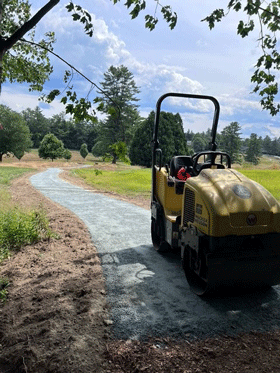
Work has also started (photo) on the accessibility trail from the former clubhouse. Avoid this trail until it’s ready but enjoy seeing the progress.

Filed Under: Lands, Pine Park, Stewardship, Trails, Uncategorized

Mink Brook Log Crossing Update

August 1, 2022

Mink Brook Log Crossing status as of August 1st, 2022

You may recall that we were planning for its replacement well before advancing rot forced us to close it last summer, starting with research into what kind of structure would conform to the restrictions in our deed. The above-mentioned erosion meant we needed longer, stronger logs than the trees growing there could provide, so we can’t just replace the log. Our terrific team of Thayer engineering students developed a well-considered plan for a new crossing in the same place, and we’ve been working since March to secure approvals from key stakeholders.

To that end, our volunteers are wandering around the Preserve interviewing visitors (again) to learn more about how and where they enjoy the land, so we can share that information with those decision-makers. We hope to have good news soon!

Filed Under: Lands, Media, Mink Brook, Stewardship, Trails Tagged With: bridge, log crossing, Mink Brook, stewardship

Pasture Road Peregrinations

June 30, 2022

DOWNLOAD FULL PDF OF DIRECTIONS -Pasture Road Peregrinations

Driving directions:

  • From Etna Village, head N on Hanover Center Road
  • Turn R on Ruddsboro Road and drive 1.8 miles
  • Turn L on Old Dana Road
  • Turn R onto Moose Mtn. Lodge Rd just past an old barn
  • Drive 0.8 miles to top of steep road. Park at the marked trailhead parking area.

What you should know:

  • Foot travel only.
  • Dogs welcome if under close control.
  • Bring binoculars for viewing waterfowl on Mill Pond.
  • This hike explores a trail newly built and blazed in spring, 2022 and visits the Dana Forest and Pasture Natural Area, co-owned by the Town of Hanover and a Dana family heir, and the privately owned Baum Conservation Area. These lands are part of a 3,800-acre contiguous block of protected higher-elevation wildlife habitat on Moose Mountain.

BRIEF HIKING DIRECTIONS

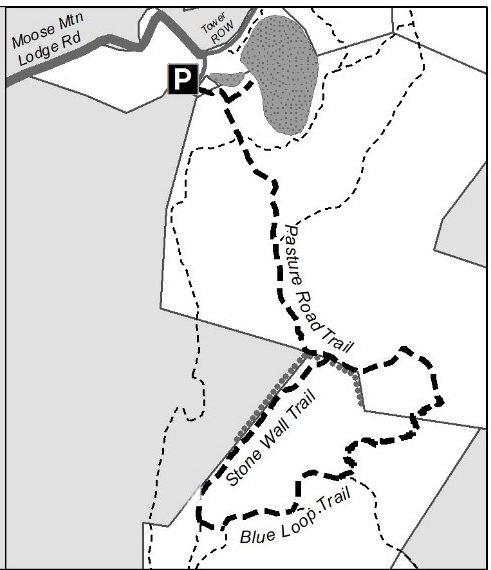
  • Begin at the sign reading “Mill Pond Forest & Huggins Trail Access.”
  • Bear L at first trail junction to visit Mill Pond
  • Return to trail junction and turn L onto Pasture Road
  • Follow signs for Pasture Road Trail.
  • Turn R onto Stone Wall Trail at gap in stone wall
  • Turn L onto Blue Loop Trail, heading downhill
  • Turn L onto Pasture Road Trail
  • Continue straight after junction with Stone Wall Trail
  • Bear L at junction with Pond Trail
  • Retrace your steps to return to your car

FULL DIRECTIONS

  • Begin your hike at the sign reading, “Mill Pond Forest & Huggins Trail Access.” To forever ensure public access to the network of trails you’ll be exploring, the Shumway and Huggins families donated conservation easements on this area to the Hanover Conservancy in 2016.
  • Cross a small drainage and note the grassy area beyond the trees at L. By 2017, the beavers left when their preferred food supply ran out, after years of entertaining their neighbors with tail slaps on the water plus plugged culverts and “free-range forestry.” The thread of infant Mink Brook has reappeared in the absence of management by these aquatic engineers, and the series of pools is growing up to grass.
  • 3 minutes’ walk from your car, bear L at the first trail junction. In 15 paces look for a cellar hole at L, difficult to see amid the lush growth at this time of year. Here stood the home of David Woodward, who built the dam on Mill Pond and a sawmill and gristmill on the small, steep falls of Mink Brook below where you left your car.
  • Continue on the path a few minutes further to Mill Pond, the highest water body in Hanover and the primary source of the town’s largest stream. Set in a saddle on the mountain ridge, it originally may have been a smaller pond or perhaps a marsh. Around 1800, Woodward built a drylaid stone dam (out of view at L, beyond the spruces) to raise the water level some 6-8 feet (since partly silted in). Beavers later took over managing water levels but since they departed, the pond has shrunk to half its size. Directly across the water is the remains of their impressive lodge. Today, the entire shoreline remains undisturbed as Hanover Conservancy easements protect the N side and the S side is the Dana Pasture Natural Area. It is this 132-acre parcel straddling the mountain ridge that we’ll traverse now
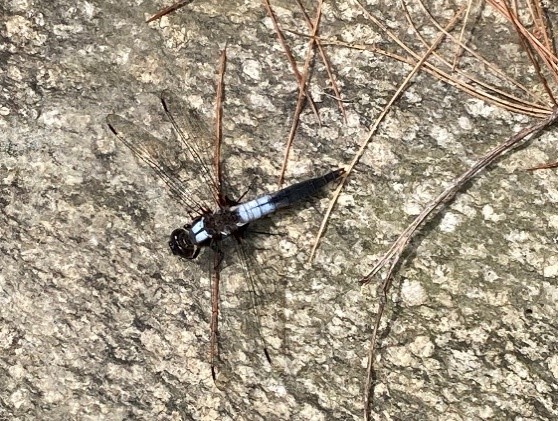
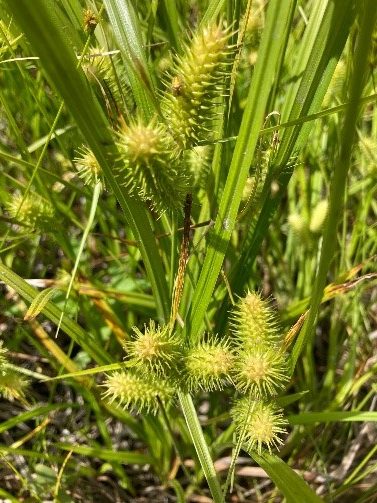
  • Scan the pond for waterfowl and other birds. On the day we visited, elegant black and white dragonflies, looking as if they were dressed for a formal affair, darted over the surface. Punctuating the green bristly growth of sedges (left) are the paired reddish (when emerging) leaves of St. John’s Wort.
  • Retrace your steps to the trail junction, marked with a sign for Pasture Road and a green moose. Turn L onto this historic Class VI road. Where it once met Moose Mountain Lodge Road is anybody’s guess – we bet it’s now under an old beaver dam.
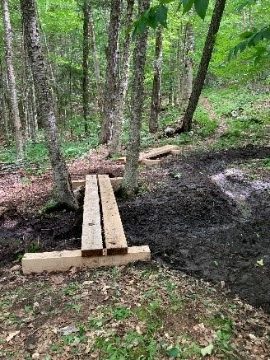
  • Pasture Road follows an old stone wall through mixed woods. You’ll soon arrive at a pair of hefty bog bridges, built in 2022 by the Upper Valley Trail Alliance’s High School Trail Corps to provide dry footing across a wet part of the old road. The road climbs gently and in a few more minutes, cross another wet area. These seeps may seem pesky to hikers but are an important part of the mountain’s water retention system, holding moisture in the soil rather than letting it run quickly downhill. This is especially important with the sudden, heavy downpours that are accompanying climate change
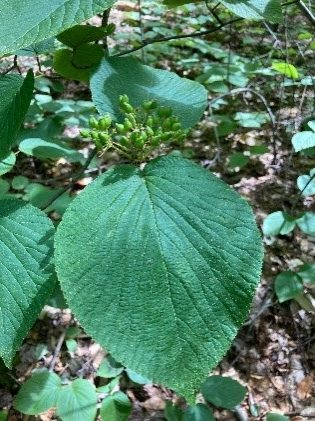
  • Note two of the “junior” members of the forest community that both feature paired leaves: striped maple, with its goose-foot shaped leaf, and hobblebush (left), a viburnum just setting fruit at this time of year. As fall approaches, it will turn a deep purple and its fruits, beloved by birds, will turn bright red
  • Four minutes’ walk from the last wetland crossing, pass the Orange Diamond Ridge Trail at L. Ahead at R is a sign for Pasture Road. Continue straight.
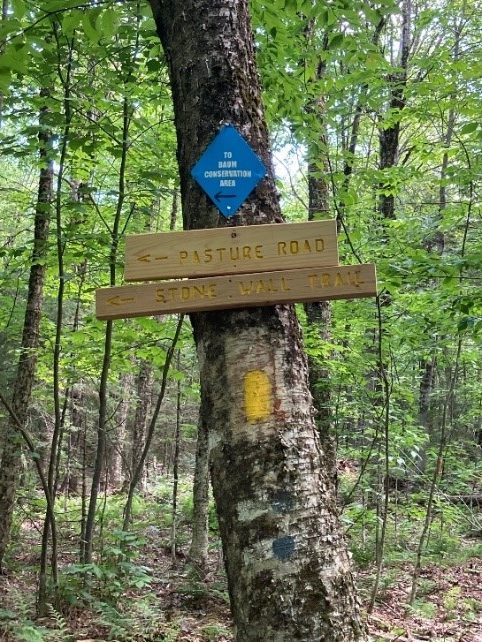
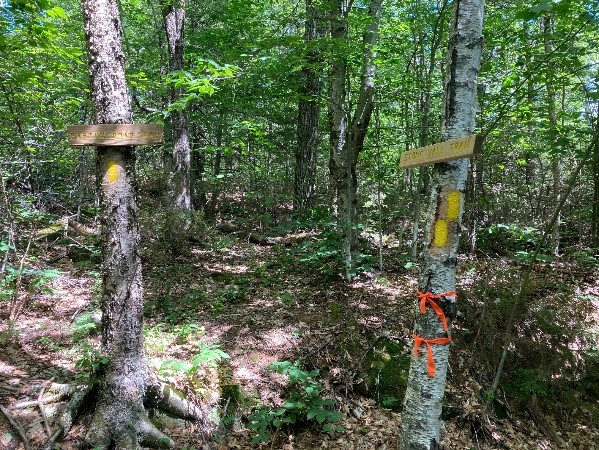
  • 8 minutes later, bear L at a set of signs posted to help you navigate the uncertain route of historic Pasture Road toward the Baum Conservation Area and Stone Wall Trail.
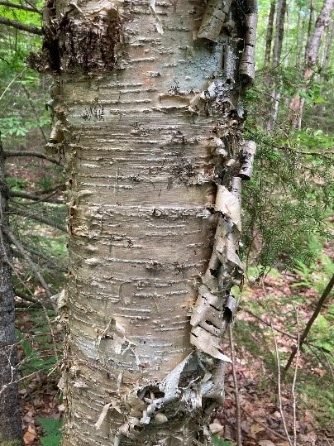
  • You’ve been passing through true northern hardwoods forest, with some of its most handsome members on display. We’re fond of the glistening golden bark of yellow birch like the one on your L (photo), a northern species that is more shade-tolerant and long lived than its familiar, iconic cousin known as canoe, paper, or white birch. The forest here looks to be about 75 years old, with beech, northern red oak, red and sugar maple, and hemlock.
  • The forest is in recovery from its years as the Dana Farm’s summering grazing grounds. The Dana family farmed this area since the late 1800s. Into the 1960s, the family drove their cattle up the mountainside to graze on the remaining open pastures in summer.
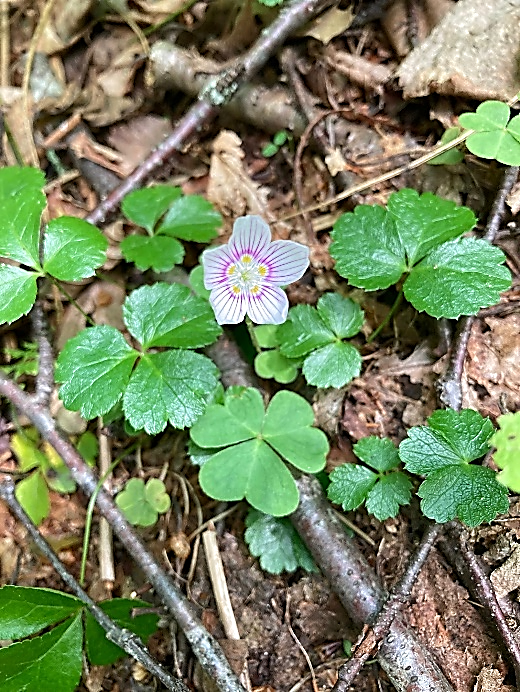
  • From the signs, continue for 7 minutes on the yellow-blazed trail, keeping an eye out for the colorful mushrooms and fungi that begin to appear at this time of year. Spring wildflowers have mostly wound down, but you may spot the delicate pink-striped white blossoms of mountain woodsorrel, Oxalis montana, shown at R mixed with the similar but glossier leaves of goldthread.
  • Suddenly, Pasture Road delivers you to a large and dramatic stone wall, built of huge, angular, coarsely laid blocks. A yellow-blazed pin indicates that the wall marks a property boundary – to the S is the Baum Conservation Area, owned by a local Dartmouth alumnus with a keen interest in trails and the public benefits of protected land. Bear L along the wall for a few minutes to a gap at the junction of the Pasture Road Trail and the new Stone Wall Trail. Take a moment to check the signage here, as you’ll be returning to this spot in a little under an hour. If your time is limited, you can just explore the Stone Wall Trail (11 minutes one way) and retrace your steps.
  • Turn R and down the hill on the Stone Wall Trail, built in 2021 to replace 2 trails retired to reduce impact on wildlife habitat. Volunteers led by the Hanover Trails Committee spent 34 person-hours in one week in 2022, blazing 10-12 miles of trails here and elsewhere. It takes lots of work, time, and bug-swatting, all powered by a spirit of good will, to provide such trails for you to enjoy.
  • On the R, the massive stone wall is in view upslope; soon you’ll notice a parallel wall at L. The forest is younger here, and wild sarsaparilla is common in the understory.
  • The Stone Wall Trail ends at a connector trail not long after the wall itself ends. Note a closed trail at R and a sign ahead on the opposite side of a tree. Continue your hike by bearing L and gently downhill, crossing a small drainage to the extensive trail system on the Baum Conservation Area.
  • 4 minutes from the Stone Wall Trail, turn L on the Blue Loop Trail and head down through a fern-covered former skid trail. In 3 minutes the trail briefly levels out. Look L for a sign reading “Blue Loop to Pasture Road” and head downhill again.
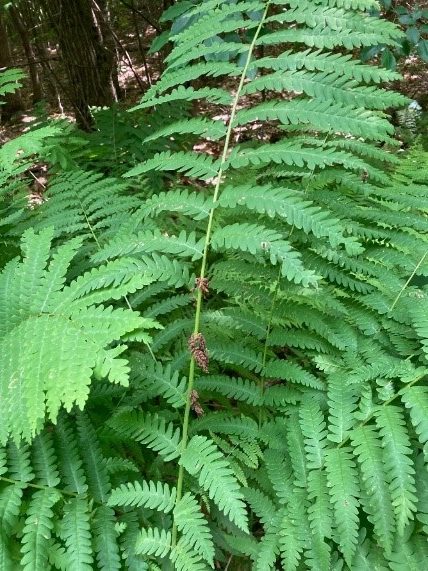
  • Enjoy this old logging road with a few short steep sections and some low ledges. Now’s a good time to admire the variety of ferns growing here – wood fern, cinnamon fern, interrupted fern (photo) and the delicate, dual-tapered New York fern. Sturdy three-part bracken fern and the coarser fronds of sensitive fern enjoy damp spots.
  • The trail bears L at the bottom of a hill. A short section of blocky stone wall is visible at L. Cross a small drainage that may be dry at this season. On the other side, back on the town’s Dana Forest and Pasture Natural Area, pick up the yellow blazes again. The trail moves gently downhill.
  • 10 minutes from your last turn, cross another drainage and look L for another Pasture Road sign. Turn L here; the Blue Loop Trail you’ve been following continues downhill. Natural stone steps lead up and the trail bends L and slabs across the slope. Keep your eye out for yellow blazes to guide you on this less-beaten path that curves up and around a ledge.
  • Here, forest patches are composed of pole-sized saplings of young beech and goose-foot (striped) maple, belying a recent forest disturbance. Arrive at an opening filled with blueberries and bracken fern and then move more steeply up into hemlocks, whose dense shade discourages understory growth. As the trail becomes less steep, note a scarred beech at L that appears to be a favorite for bucks to rub velvet off their antlers. Pine and oak join the hemlocks. The flute-like calls of the wood thrush provide orchestration for your hike. The wind in the trees overhead reminds that you’re climbing on a mountain ridge.
  • The trail reaches the top of a gentle ascent and bears L. Mossy flat stones decorate the treadway. In 2 minutes another stone wall appears ahead. Bear R to keep it on your L. The angular flat rock at L bears evidence of many squirrel picnics.
  • The wall follows the Baum/Dana boundary, and the trail takes a sharp R where the wall meets a ledge.
  • 4 minutes from your meeting with the wall, you’re back at the signed junction with the Stone Wall Trail, closing the loop. Continue straight on the Pasture Road Trail, keeping that impressive wall on your L; bear R to follow the yellow blazes.
  • What are such massive stone walls doing in the forests of Moose Mountain? When they were built, likely during the Sheep Craze of 1820-1850, the forests were largely gone, cut to provide building materials, heat, and especially open pastures for merino sheep. In 1840, there were over 11,000 sheep grazing Hanover’s hillsides, tended by a human population of only 2,800. As the region’s wool market and textile industry succumbed to competition from the Midwest and South in the Civil War era, the departure of nibbling sheep allowed the forest to return, yet the timeless walls remained.
  • Continue straight (N) on the Pasture Road Trail, passing several signs for the Orange Diamond Ridge Trail. As you go, note signs of forest succession – dead snags of white birch, blowdowns, and more. All these are signs of rejuvenation and provide habitat for various birds and small mammals.
  • 10 minutes from the Stone Wall Trail stay L on the Pasture Road trail. The opening visible through the trees off to the R is the S end of Mill Pond, filling in with grasses now that beavers are no longer maintaining their improvements on David Woodard’s dam. If the beavers do not return, you’ll soon find alders and other wet-tolerant woody plants here. Eventually, the forest will reclaim this space.
  • Pasture Road’s more formal walls accompany you until you arrive at the path at R leading to the water. Turn L at this fork to return to your car.

July, 2022

Thanks to the Coop Food Stores’

program for supporting this hike of the month 

Filed Under: Bears, Birds, Conservation, Deer, Hike of the Month, History, July, Lands, Moose Mountain, Trails, Wildlife

9th Annual Hanover Trails Hike Challenge

June 29, 2022

Sign up now for the 9th Annual Hanover Trails Hike Challenge! This do-at-your-own-pace hiking challenge will introduce you to 8 trails around town that hikers of all ages will love.

Register through Hanover Parks & Rec to receive a colorful t-shirt and your booklet with maps & detailed directions to each destination.Register through HPR here for $6/Individual, $20 for family 4 or more, free/children under 4 https://hanovernh.myrec.com/…/program_details.aspx…Complete 6 of 8 hikes by the end of September and be entered in a raffle for great prizes donated by local businesses.

Sponsored by LindeMac Real Estate, BE Fit Physical Therapy , ReVision Energy, Lou’s Restaurant & Bakery, and New England Free Jacks–THANK YOU!

Summer is here…Get Outside & Explore!Maps created by Stonehouse Mtn Mapping; T-shirt design by Big Green T’s

Filed Under: Events, Outdoor Trips, Partnerships, Trails Tagged With: Hanover Parks & Rec, hike, Town of Hanover, trails, Trails Challenge

  • 1
  • 2
  • 3
  • …
  • 11
  • Next Page »

71 Lyme Road
Hanover, NH 03755
(603) 643-3433

info@hanoverconservancy.org

Facebook logo   Instagram   YouTube

Get Involved

Become a Member

Volunteer

Business Sponsors

Conserve Your Land

Employment

Our Mission

Advocacy

Conservation

Education

Stewardship

Explore Hanover

Hanover Hikes

Upcoming Events

Upper Valley Hikes

Trails Challenge

Copyright © 2025 Hanover Conservancy | Design by Chase Brook Software