Hanover Conservancy

Facebook logo   Instagram   YouTube          
Donate button
  • Home
  • About Us
    • Employment
    • What We Do
      • Advocacy
      • Conservation
      • Education
      • Stewardship
    • Celebrating 60 Years
    • Board & Staff
    • Membership Benefits
    • Contact Us
  • Get Outdoors
    • Hanover Lands
      • Balch Hill Natural Area
      • Mink Brook Nature Preserve
      • Other Properties
    • Hanover Hikes
    • Hanover Trails Challenge
    • Upper Valley Hikes
    • Exploring Nature at Home
    • Hunting
  • Events
    • Calendar
    • Spring Wildflower Scavenger Hunt
    • Private Events
  • Get Involved
    • Donate
    • Volunteer
    • Adopt a Trail
    • Corporate Conservators
    • Planned Giving
  • Education
    • School Programs
      • KAST
      • Connecticut River Studies
      • Hanover High School Scholarship
    • Request a Field Trip or Speaker
    • Research on Our Lands
    • Hanover History
    • Resources
  • News
    • Remembering Bob Norman
    • Reports & e-News
  • Conserve Your Land

Old & New Etna Loop

September 29, 2020

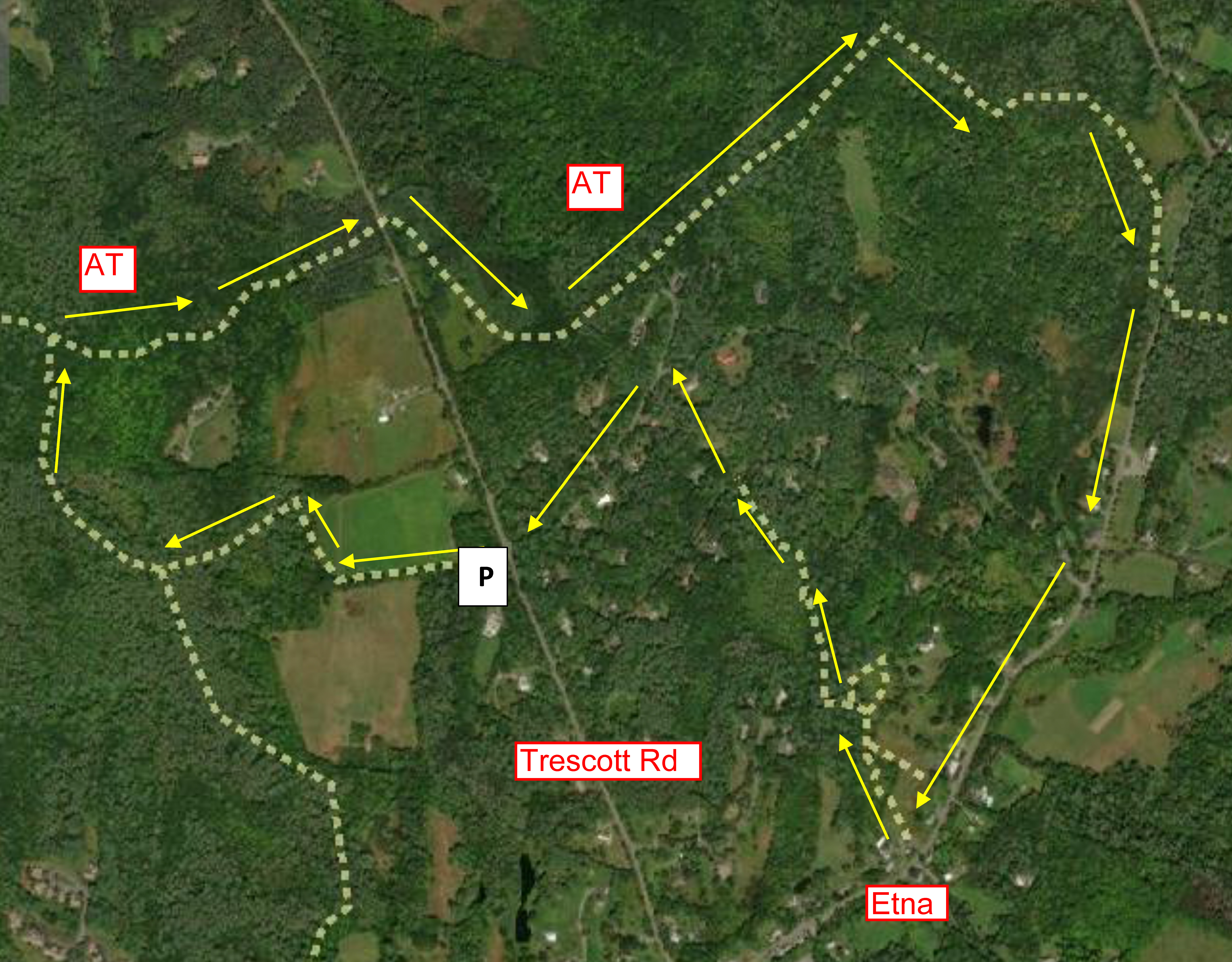
HIKE DIRECTIONS & MAP – Full PDF

Driving Directions

  • From Etna, take Trescott Rd northwest for 0.5 miles to the junction with Partridge Rd.
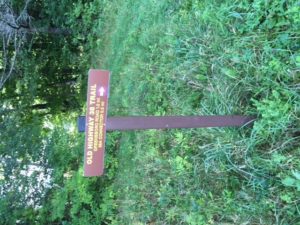
  • Park in the parking area on the L (W) side of the road at the blue sign reading “Old Highway 38 Trail.” If the area is not accessible, continue up Trescott Rd 0.4 miles to the AT parking lot at R, just before a fence at the Trescott Water Supply Lands.
  • Today’s hike is a loop through the Hudson Farm’s fields and forest on an historic highway, behind Etna village on the famed Appalachian Trail, and down Hanover Center Rd. to the Etna Library, the Audrey McCollum Trail, and Partridge Rd.

What you should know
  • This is a mostly easy hike with a few short steeper sections and some with tricky footing among roots or rocks. The route is well-blazed and signed.
  • The route follows an early road on one of Hanover’s newest conservation lands. In 2017, the Hudson Farm (brown-shaded area on map) was permanently protected as part of the Appalachian Trail corridor.
  • The Audrey McCollum Trail, built by the Hanover Trails Committee from Hayes Farm Park to Woodcock Lane in 2017, was extended in Summer 2020 to Partridge Lane to provide improved access to the central conservation area owned by the Town of Hanover.
  • Trails are maintained by Trails Committee volunteers.
  • Dogs are welcome but must be under your control and must be leashed on the McCollum Trail; please pick up after your pet.
  • Deer hunting is permitted (except at Hayes Farm Park) by archery Sept. 15-Dec. 15
  • Foot travel only; snowmobiles, ATVs, and bicycles are not permitted.
  • Please respect nearby private property.
BRIEF HIKING DIRECTIONS

  • From the Hudson Farm parking area, take Old Highway 38 south to the rise in the meadow.
  • Turn R at sign for Old Highway 38 Trail and 38A Connector.
  • Stay straight at next trail junction; turn R at T toward Appalachian Trail.
  • Turn R (N) on AT, cross Trescott Road, and continue on AT to Hanover Center Road.
  • Turn R (S) on Hanover Center Road; follow to Etna Library.
  • Turn R into parking lot and take trail into meadow to junction with Audrey McCollum Trail.
  • Bear L onto Audrey McCollum Trail; follow this to Woodcock Lane.
  • Turn R onto Woodcock Lane and then L to new section of McCollum Trail.
  • Follow this to Partridge Road.
  • Turn L and walk along Partridge Road to Trescott Road; cross to reach your car.

FULL DIRECTIONS

  • Begin your hike by passing the kiosk and taking Old Highway 38 along the treeline up to the rise that is visible from the trailhead. At this season, the old field is filled with nodding goldenrod, small white asters, and periwinkle New England asters. Start “collecting” stone walls! Among the leaves cloaking the hedgerow at L is the first, a low stone wall separating two former pastures of the historic Adams Farm.
  • 5 minutes’ walk brings you to the top of the rise and a brown/yellow trail sign where two mown paths meet. Look back at R – easily visible is a white 20th century home built as a country retreat by retired architect Archer Hudson. Beyond another hedgerow stood the Adams Farm house from 1790 until 2024, a former tavern and home of the family that once owned the former farmland you are exploring now. Hudson purchased land that included the Adams barn – and then burned it down. Dartmouth College later bought the property and carved off his house for resale.  While the College referred to it as the “Hudson Farm,” the land ceased to be farmed when Hudson arrived.
  • In June, 2017, this was the site of a grand celebration. A partnership between the Trust for Public Land and the Town of Hanover, assisted by the Hanover Conservancy, resulted in the purchase of 175 acres by the National Park Service to permanently protect them as part of the Appalachian Trail corridor. In addition to major federal funding, many local contributions made this possible.  Owned for many years by Dartmouth, the property had been eyed as a site for everything from a cemetery and golf course to a housing development. Today, the AT Conservancy manages the land with help from the staff of the White Mountain National Forest.  The beautiful meadows are kept open by carefully prescribed burns, for their spectacular views and valuable grassland bird habitat.
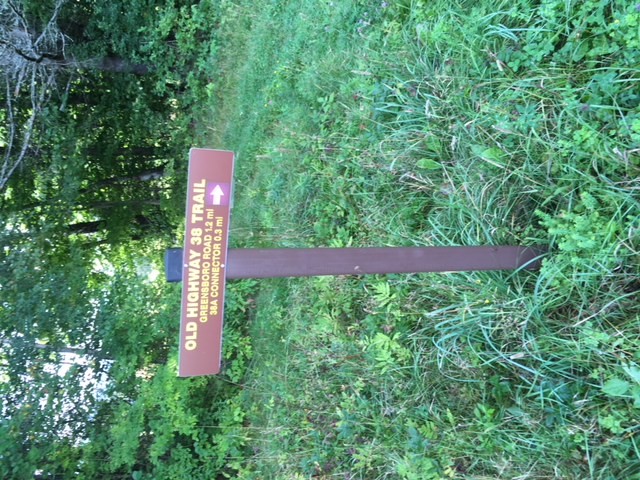
  • Turn R at the sign to follow the Old Highway 38 Trail and pick up the 38A Connector. The trail heads down to the woods; crabapples at the edge, a remnant of farming days, bear colorful fruit at this time of year. Yellow blazes mark the trail.
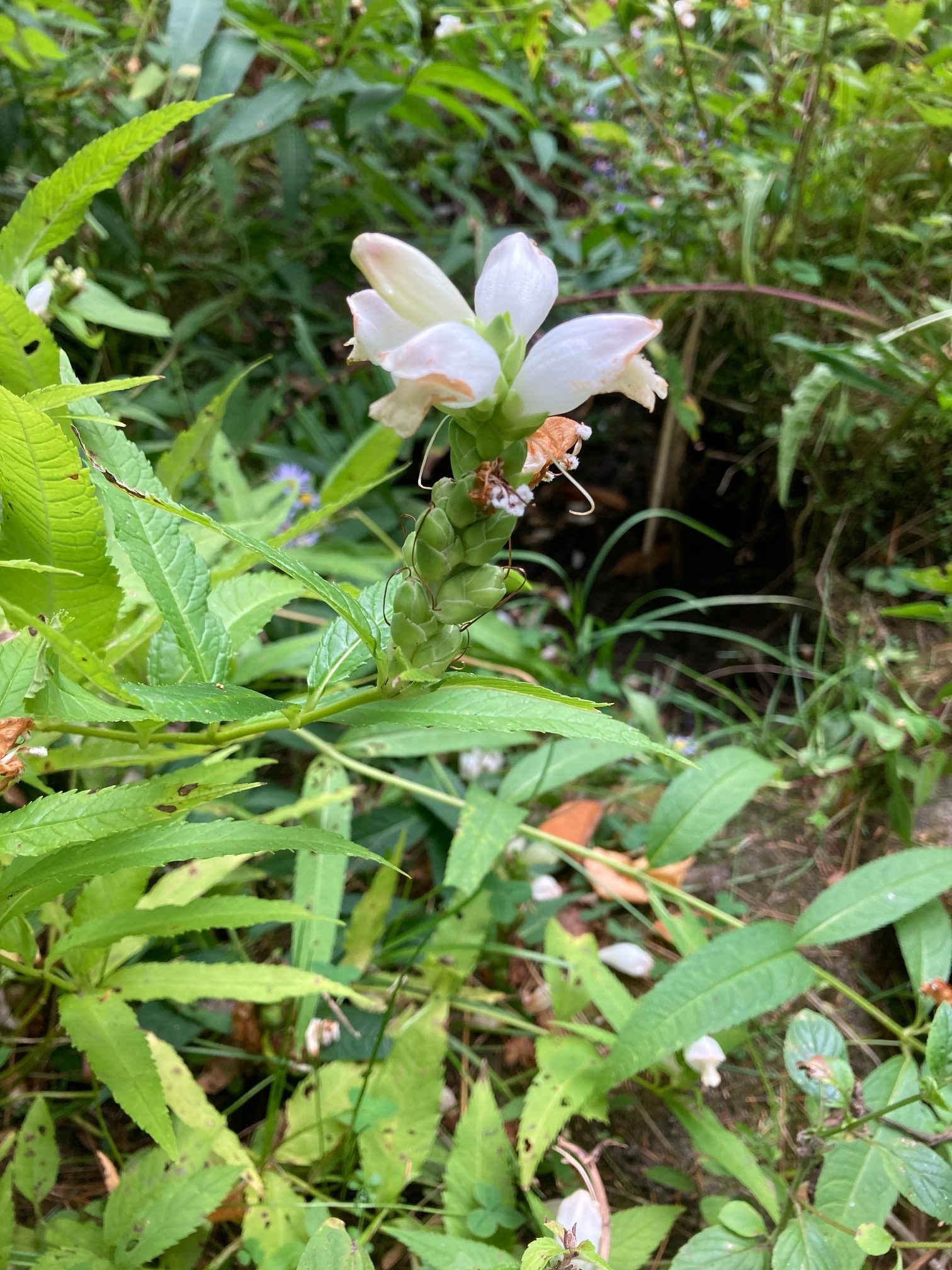
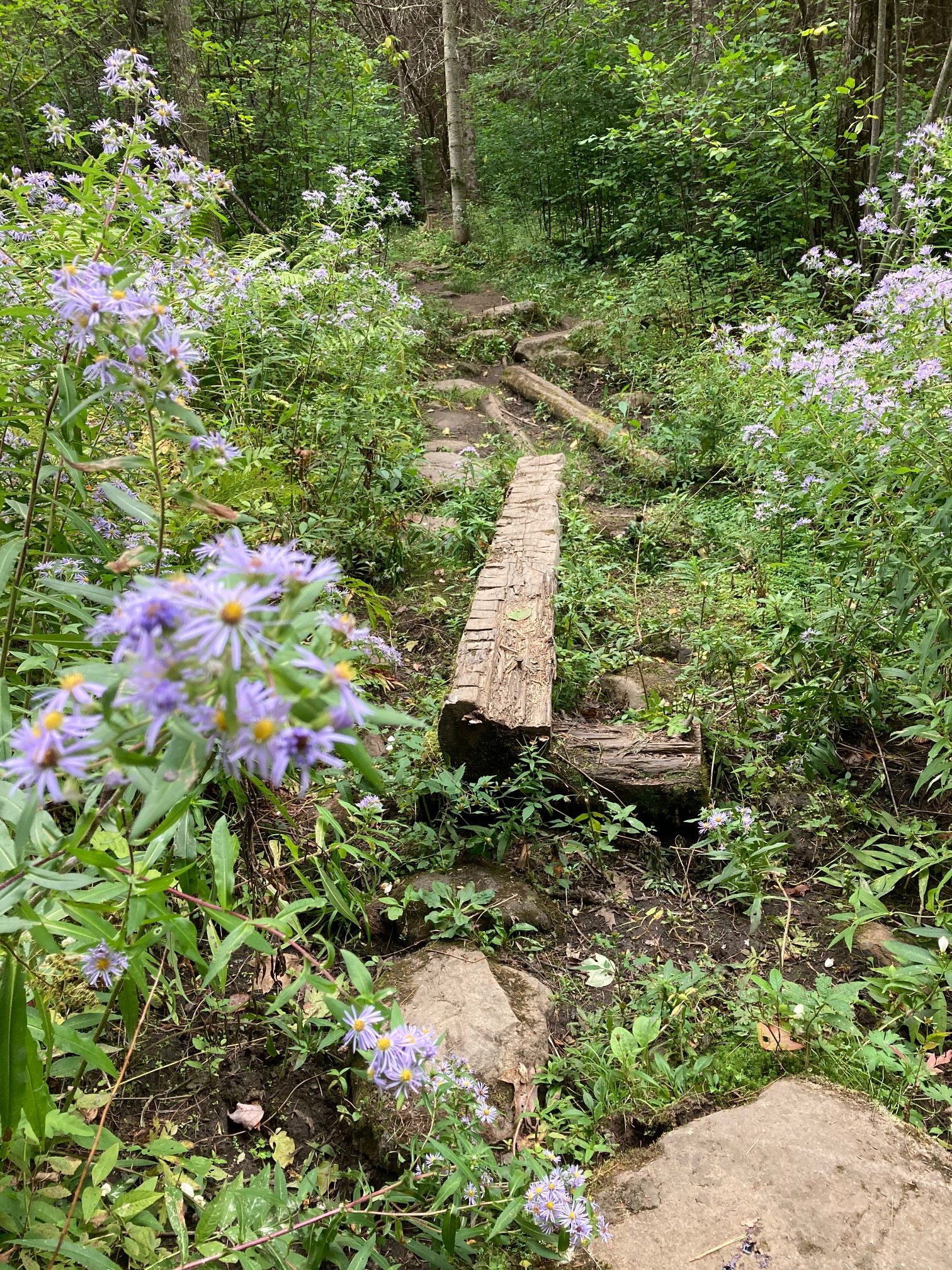
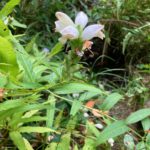
  • Two sets of boardwalks offer dry footing across a wetland, built by Hanover Trails Committee volunteers (thank you!). Protecting such headwater wetlands and streams from heavy foot traffic benefits water quality and trout habitat in Mink Brook below. The wetlands act as sponges during heavy downpours, holding water to prevent flooding and erosion in downstream neighborhoods. While they may seem dry at this time of year, the coarse fronds of sensitive fern are a clue to wetter times. Keep an eye out for the intriguing white flowers of turtlehead. Their bee pollinators must muscle their way inside to gather their nectar.
  • Rising up and away from the wetland, you’ll soon see a pair of stone walls at R, reminders that this was once grazing land before the forest returned. The second turns a corner and follows the trail.
  • 7 minutes’ hike from the first trail sign, note another at L where Highway 38 turns L. You continue straight on the 38A Connector for 0.3 miles to the Appalachian Trail.
  • Head over stepping stones on what may be a dry crossing at this season. The trail is now blazed blue, indicating a, AT connection trail. The rolling trail moves through mixed woods in former pastures.
  • 5 minutes from the last junction, arrive at a T. Blue and white arrow signs in nearby trees (which seem eager to devour them) mark your R turn down the hill, following blue blazes. Mark the time – you’ll see why.
  • As you approach the clearly marked boundary of the old AT corridor – an 1800s stone wall, 1980s yellow blazes, and a 2017 boundary pin – you note that the forest understory is more open here. This land has a different history.
  • 10 minutes from your last turn, reach the pine-needle strewn crossing of the Appalachian Trail. It is easy to miss! The connector trail continues beyond the AT, bending around a yellow birch about 50’ ahead. Stop and look for the white blaze on a pine at R.
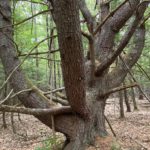
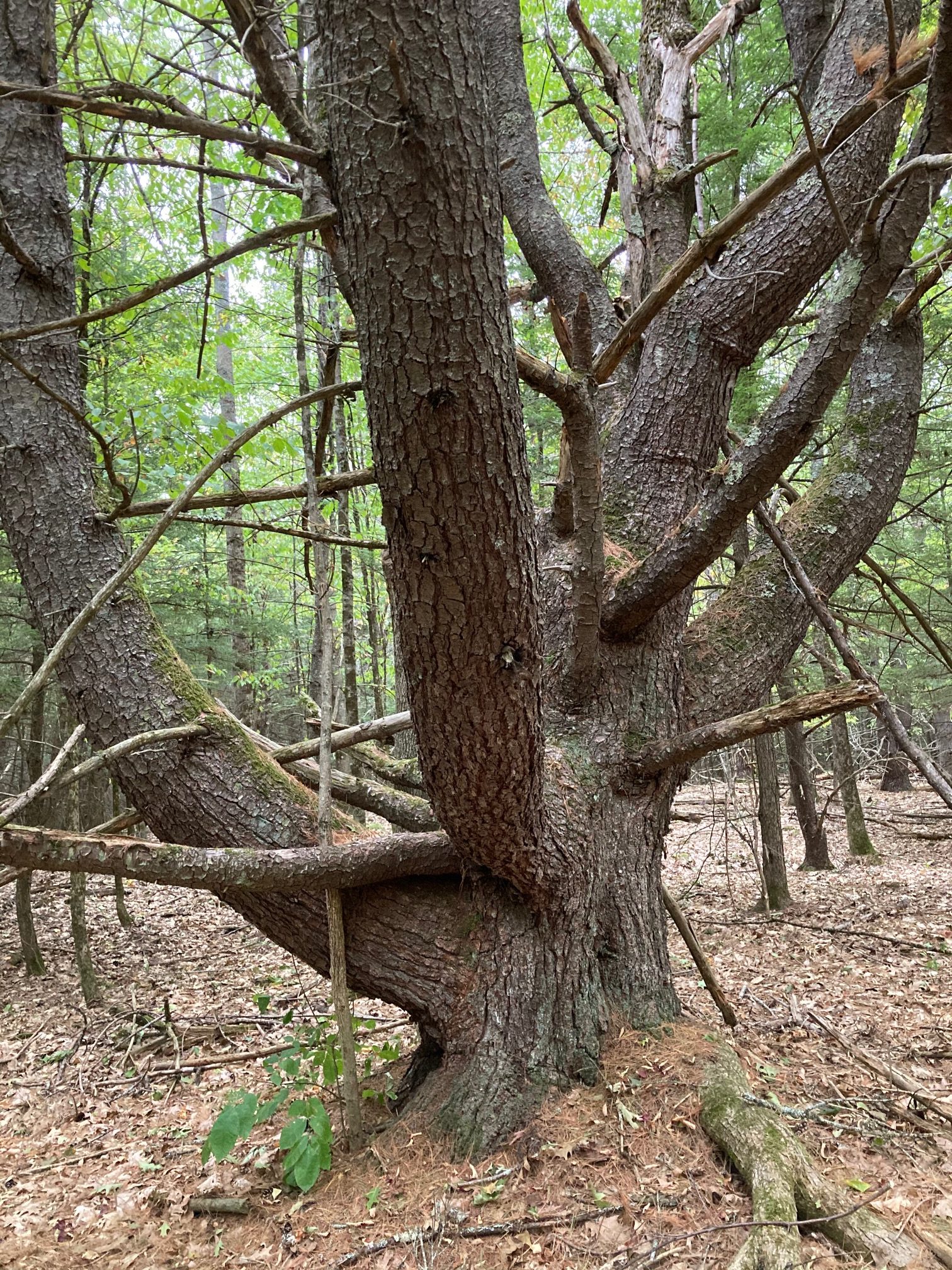
  • Turn R onto the famed – but here quite humble – Appalachian Trail, heading gently up for 7 minutes to the top of a low ridge. Stop here and note the big old “wolf pine” at L, a pretty impressive character. The growing tip of such a white pine was damaged early in its career, which let side branches develop into competing leaders. No longer valuable for timber, such pines were often left to provide shade for grazing animals – and to spook hikers.
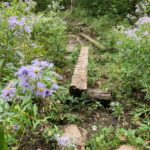
  • 4 minutes later, cross another small wetland decorated with asters and turtlehead.
  • On the far side, the forest understory is suddenly crowded with young buckthorn, an invasive tree. At this season, when most proper New England trees are beginning to shed their leaves or at least turn color, the non-native buckthorn reveals the secret to its grim success – it retains its green leaves and keeps on photosynthesizing well after the natives have checked out for the winter, giving it a competitive edge.
  • 4 minutes past the wetland crossing, arrive at Trescott Road. On the day we were out, during a drought, a thoughtful “trail angel” had left a cooler and big water bottle for thirsty hikers.
  • To continue on the AT, spot the trail across the road at one o’clock. A few steps in, a kiosk appears ahead. A path from the AT parking lot comes in at L, strewn with needles from the pine plantation it crosses.
  • Continue past the kiosk through thickly planted rows of pines, another part of the old farm that is now owned by the National Park Service.
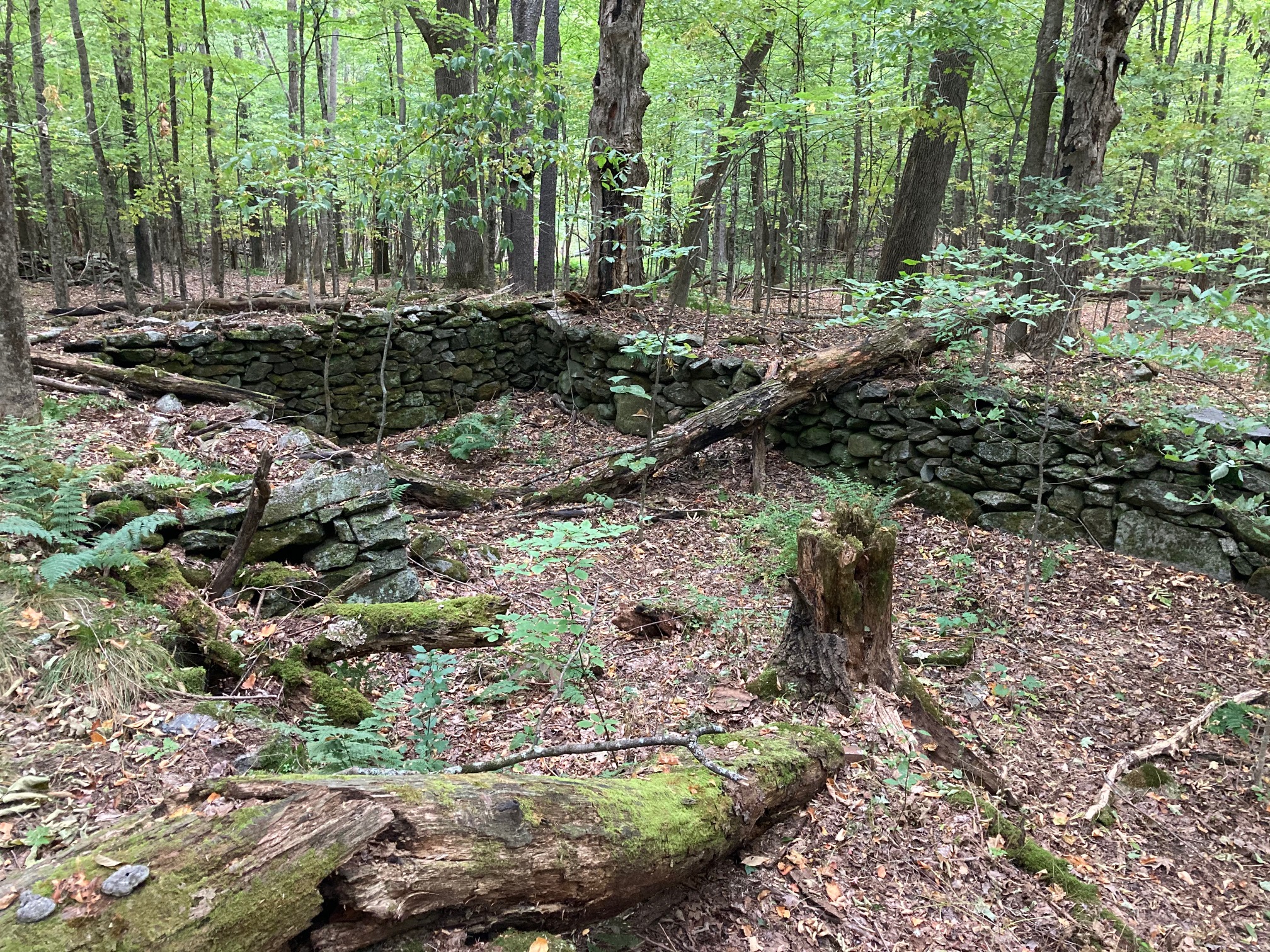
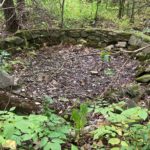
  • After a small opening, watch for an odd rectangular structure of moss-covered concrete at R – was this the farm’s spring house? A few steps further is a spectacular round drylaid stone structure – possibly the foundation of a silo. Etna’s farming history is deep and rich – and its footprints are everywhere.
  • 5 minutes from Trescott Rd, emerge into an opening where the trail skirts the upper edge of the recently reclaimed meadow. A stone wall (the fifth or sixth so far?) appears at R as the trail re-enters the woods. As you leave the Trescott Rd corridor behind, invasive buckthorn in the understory is replaced by native cherry, ash, and striped maple.
  • The AT crosses a low stone wall as you note many blowdowns. These may date from the 2007 Patriot’s Day windstorm that leveled much timber here and on the east slope of Balch Hill, among other places.
  • Cross another stone wall, this one remarkable for its long, angular slabs. Who knew stone walls had different personalities? We’ve only just begun!
  • Continue north on the AT as it rolls along, skirting the W edge of Etna village. Cross yet another stone wall.
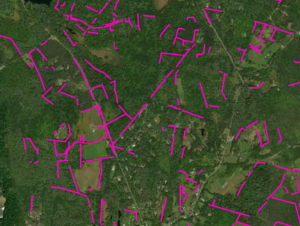
  • The trail bears L, arriving at an interesting intersection of stone walls that once must have divided pastures. The AT follows one on your L – note some venerable sugar maples lining it. As the trail rises, this wall becomes even more impressive, nearly reaching chest height. We can’t resist sharing here that in 1870, a government agency estimated that over a quarter million miles of drylaid stone wall had been built in New England and New York, most during a few decades in the early 19th century during the Sheep Craze. Recently, NH’s State Geologist has worked with area volunteers and UNH to create a citizen-based, on-line stone wall mapping tool using LiDAR maps. You can visit this site to see the stone walls you’re “collecting” on this hike (shown in pink on the image), and visit your own home area to see what other walls might exist nearby.
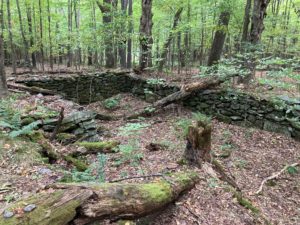
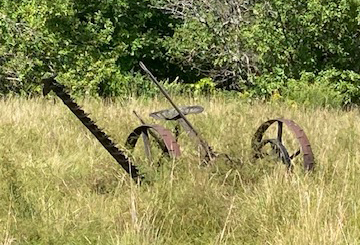
  • 5 minutes after crossing the last wall, you reach a height of land. A trail joins at R from the nearby neighborhood, and low wooden signs – along with a mystery object made of iron – invite you to stop and look around. Off just a few paces at L is a large and impressive cellar hole. It is the remains of another Adams farmhouse you’ve discovered. The Adams family once owned all the land between Dogford Rd and the E leg of Trescott Rd, over which you have been walking. When the farm was sold and subdivided to create the Trescott Ridge subdivision in the 1960s, Partridge Rd was re-routed and the Adams farmhouse (R) was removed – another piece of Etna history lost.
  • Continue straight on the AT, following white blazes to avoid a few cross-trails here. Within sight of the cellar hole, another wooden trail marker tells you to turn R; a brush pile blocks the incorrect path ahead. Add to your stone wall collection as you encounter more, many marked with old maples. Did these walls border a garden, a pasture, a cart path, a sheep pen, a lane, or were they just convenient places to store the stones?
  • 10 minutes past the cellar hole, descend toward a plush green wetland, startlingly green at this time of year. The spicy fragrance of drying hay-scented ferns is pleasing.
  • A plank crossing brings you over an often-dry streambed and the path twists toward an open field. On a summer morning, hawks may be hunting mice and other wee things from the perches above.
  • Just inside the meadow, the trodden path forks; bear R and skirt the old field through eye-high goldenrod before reentering the woods. The same dry streambed appears at L and you’ll soon cross it on a log bridge.
  • The trail passes behind the Etna cemetery, where many of those who built the walls and farms of Etna rest.
  • 7 minutes after entering the field, arrive at Hanover Center Road and turn R. A short, more civilized walk along the road gives a fresh view of the forested wetland you just passed.
  • Some of Etna’s most historic buildings – Trumbull Hall and the brick First Baptist Church of Hanover at L, and the former parsonage in the red cape at R – announce your arrival at what was once known as Mill Village, for the many mills that made busy use of the power of Mink Brook.
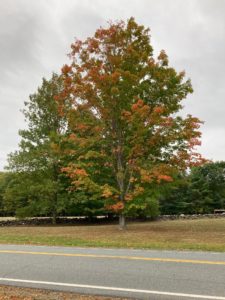
  • At Ruddsboro Road, a beautiful stone wall (the 13th or 15th?) creates a centuries-old hypotenuse between the roads. This scenic triangle has been protected by the Town of Hanover. It is part of nearby Mink Meadow Farm, home to a long-time Etna farm family. On one side of the historic Yankee-style barn is the foundation of an old silo – on the other, a tiny former milkhouse that now boasts refrigerated eggs and farm-grown vegetables.
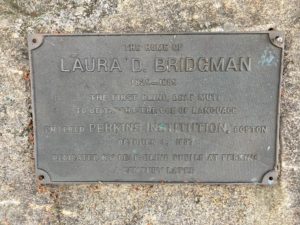
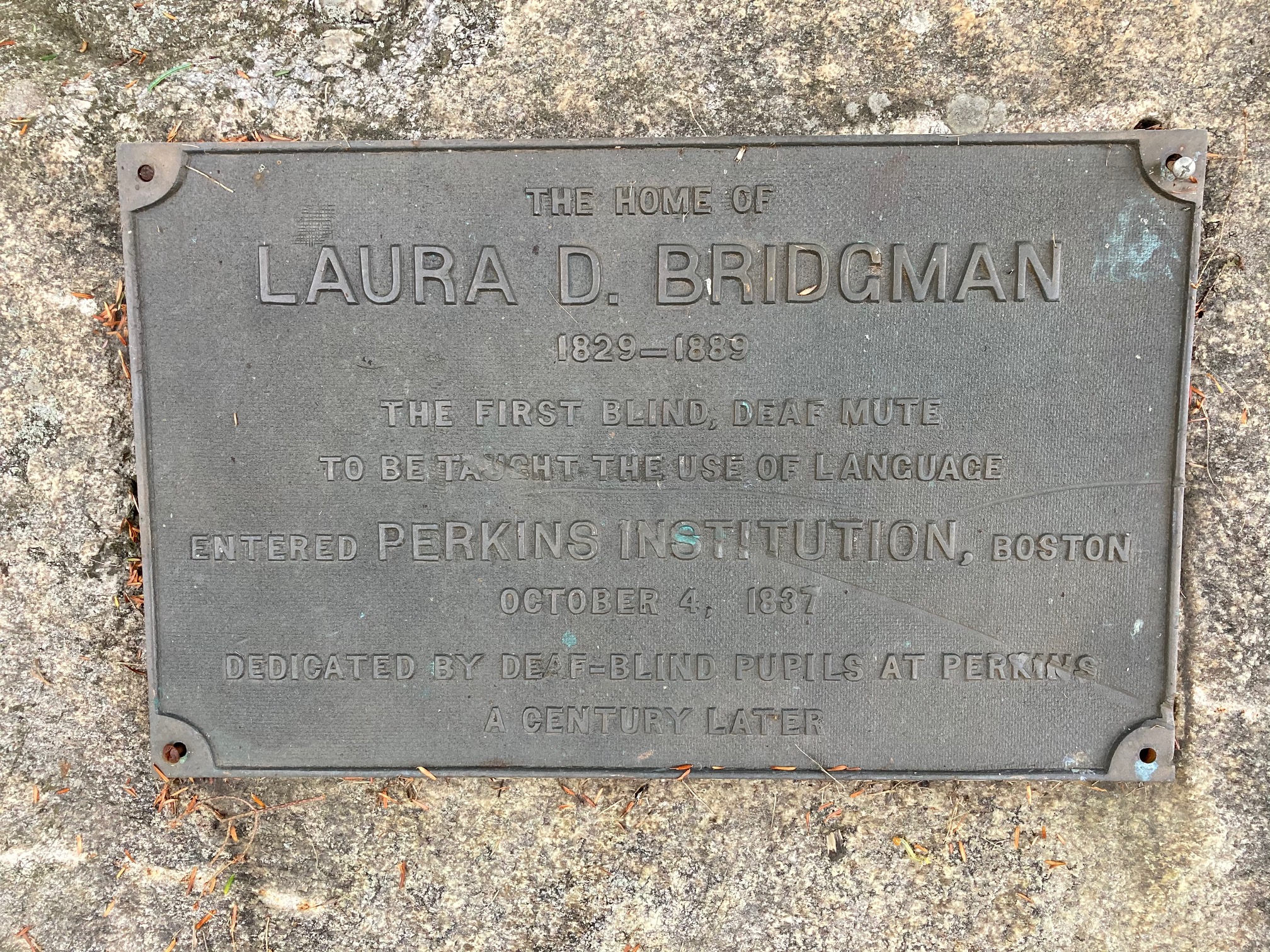
  • At R is the white 1767 Bridgeman House; the earliest part of this home is likely the middle section with the chimney. Take a moment to read the plaque mounted on the nearby stone. A tributary of Mink Brook passes behind the home and under the road.
  • Across the way, electric fencing excludes grazing cattle from the mainstem of Mink Brook, protecting water quality by allowing a lush buffer of native plants to grow along the stream to filter runoff. The farm family worked with the Connecticut River Conservancy to establish the fence and plant stream-side shrubs to keep the stream clean. For well over a century, waste from the entire village – including mill waste – was piped directly into the brook.
  • Don’t look now, but stone walls are everywhere in Etna village – among the most beautiful in town.
  • Pass the new fire station at R, and note the historic one ahead at L, a small gray clapboard building.
  • 10 minutes from the farmstand, arrive at Etna Library, one of only three structures in Hanover listed on the National Register of Historic Places. Turn into the parking lot and pick up the trail at the far end.
  • You’re entering Hayes Farm Park, acquired by the Town of Hanover in 2010 from the Hayes family whose farmstead and barn stand nearby at L.
  • Walk up through the meadow toward the kiosk. Glance beyond it at the impressive glacial erratic with early 19th century graffiti done by H. L. Huntington (for whom Huntington Hill takes its name). Take the R fork and continue straight through the meadow, up and around the corner, and through a gap in yet another stone wall. Here, the trail turns R and follows an early farm lane lined with beautiful high stone walls adorned by black, grey, and white lichens. How many tons of stone were moved to create the walls that stitch this rural landscape together? And all without machinery, just with man and animal muscle, patience, a good understanding of physics and gravity, and maybe not much else to do at certain times of year.
  • The path heads uphill to a fork marked by a sign indicating the King Sanctuary ahead and the path to Woodcock Lane to the L. Bear L as you gain the knoll – the wall makes the corner with you.
  • At L is a low cage protecting Trillium from deer browse. This is part of a deer monitoring project being of the Conservation Commission’s Biodiversity Committee. A few feet further stands a sign for the Audrey McCollum Trail. Stay L as the trodden path forks and follow Audrey’s Trail down into the woods, following yellow blazes. Bear immediately R on the needle-strewn path.
  • An ardent and well-known local conservationist, Audrey McCollum lived nearby on Trescott Road. Gifts in her memory allowed the creation of this trail in 2017.

  • Be sure to leash your dog here – porcupines den nearby!
  • Cross another stone wall and skirt the Trescott Wetlands on the somewhat rooty and rocky trail at the base of a dark hemlock and pine-covered slope. Contrast the stony hillside with the lush green ferny wetland at L. Audrey’s Trail goes over a few log crossings as you make your way around the wetland. Take care to stay on the trail and avoid nearby yards.
  • 10 minutes from the start of Audrey’s Trail, arrive at Woodcock Lane. Turn R toward the lane’s end and L at a sign just before the driveways. Be sure to keep your dog leashed, and please pick up after it.
  • This new section of trail was completed in September 2020 after much planning and effort by the Hanover Trails Committee. It provides a welcome path for “bird road” and other Etna residents to explore the natural parts of their neighborhood and to visit friends.
  • The pleasant yellow-blazed trail soon crosses a stone wall (watch your footing for wobblers) and enters the woods. Five minutes later the trail uses a log crossing near a small wetland that is likely a pool earlier in the year. This is a good place to look for animal tracks.
  • Turn L onto Partridge Road and enjoy the 8-minute stroll along this pretty lane. “Collect” your final stone wall at #3 Partridge, where a handsome historic wall has become a valued landscape feature for a later home.
  • Your car appears ahead, across Trescott Road.

This Hanover Hike of the Month has been generously sponsored by…
Filed Under: Hike of the Month, History, Hudson Farm, Invasive Species, King Bird Preserve/Hayes Farm Park, October, Trails Tagged With: stone walls

Huntington Hill North Loop

August 25, 2020

Driving Directions

  • From downtown Hanover, head N on Lyme Road (Route 10)
  • 6 miles after passing Kendal, turn R on Goodfellow Road
  • Head uphill for 0.7 mile; pavement ends near historic white farmhouse on R
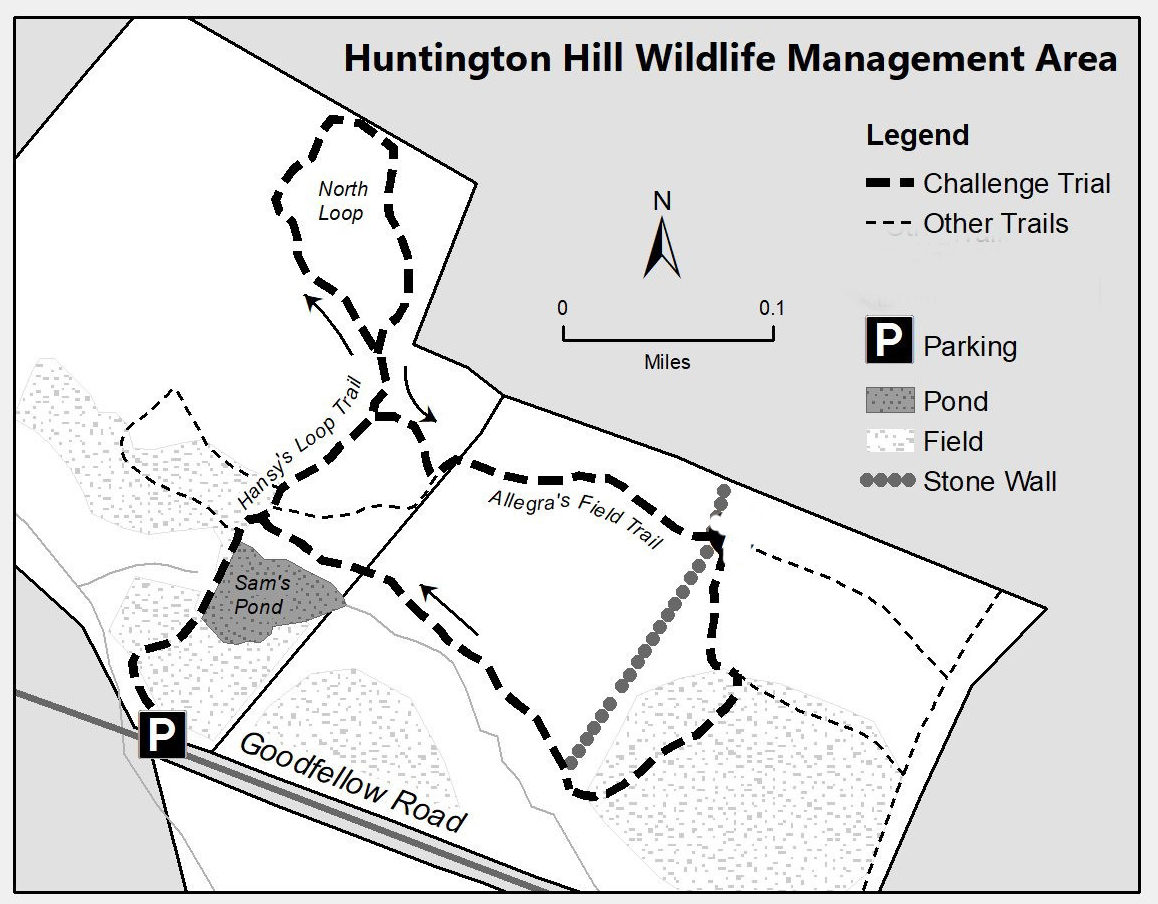
  • Park in pull-off on L (north) side of road near gate. A sign reads “foot travel welcome.”huntington hill north map

What You Should Know

  • Today’s hike is a pair of loops on permanently protected, privately owned land. Please respect the generosity of landowners who provide public access, and pack out your trash.
  • Much of this route travels over wide and less-used trails – old farm lanes and mowed meadow paths – allowing for ample physical distancing while enjoying the outdoors.
  • Dogs must be under your close control. Please pick up after your pet.

Brief Hiking Directions

  • Walk around the gate and follow the mowed path to Sam’s Pond.
  • Beyond the pond, bear L at a fork
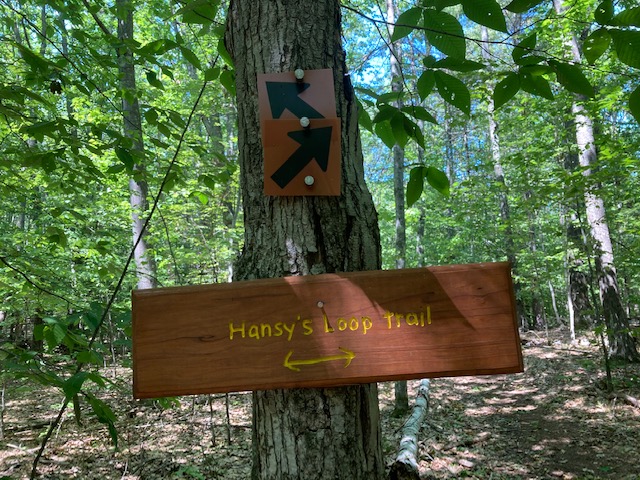
  • Bear L at another fork labeled “Hansy’s Loop”
  • Bear L at another fork with arrows pointing both ways and sign reading “Hansy’s Loop”
  • Returning to this point, return on the trail traveled earlier but turn L just past a large fallen tree on R
  • Turn L at T at a stone wall to follow Allegra’s Field Trail
  • Cross a second stone wall and bear R
  • After reaching a second meadow, bear R and down to the pond
  • Turn L to cross the pond’s dam and return to your car.Pond on Huntington Hill

The Full Story

  • Begin by walking around the gate and following the mowed path as it winds through a pleasant meadow.
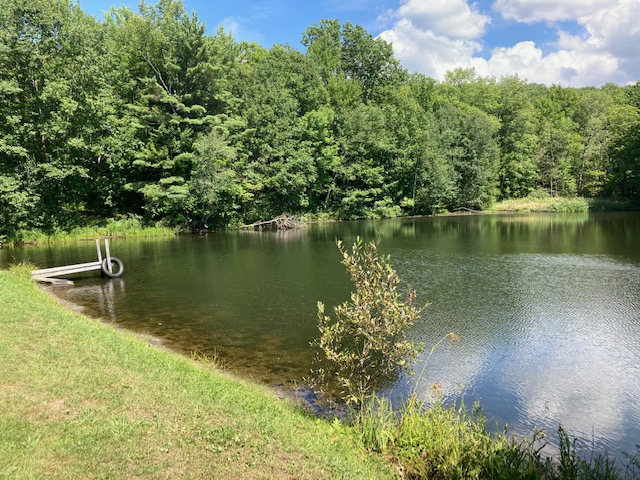
  • An expanse of water appears ahead – you’ve found Sam’s Pond.
  • Pause by the small dock for a moment to contemplate the major conservation success that allows you to visit today. You’re walking through 83 beautiful acres that are part of the permanently protected Huntington Hill property. Dr. Sam Doyle purchased this land in 1991 and conveyed a conservation easement on six parcels, including this one, to the NH Fish and Game Department. On the S side of Goodfellow Road, the property spans another 417 acres. Other adjacent conservation lands, including the Moister Meadow (20 acres, easement held by the Hanover Conservancy), the Mudge land (8 acres, easement held by Fish & Game) and the Nutt Farm (207 acres, easements held by Society for Protection of NH Forests) bring the total of protected, connected wildlife habitat to a stunning 735 acres. (See map on next page, where these areas appear in dark green). Today, Huntington Hill continues under a new family, with the original protections intact (see p.4).
  • Continue across the earthen dam to the far side, and bear L through another meadow. The coarse fronds of sensitive fern at L tell you that area is damp without the need to feel the soil. Drier parts of the upland meadow are studded at this season with the nodding white flowers of Queen Anne’s Lace. Continue straight as a second mown path comes in at L. Your trail soon swings to the R and up into the woods, returning to the N edge of the meadow, where the pond comes back into view. At the far edge, look L for a yellow-highlighted sign reading “Hansy’s Loop.”
  • Bear L here, walking up and away from the pond. After a few minutes, an orange arrow guides you to bear L.
  • A large blowdown at L gives an intimate view of the fallen tree’s root system and the light soil in which it grew.
  • 5 minutes from the last junction, arrive at another fork with arrows pointing both ways, and bear L.
  • Travel gently down through a mixed age forest of pine, northern red oak, and other hardwoods. These are taking the place of an earlier stand of white birch, whose fallen members litter the forest floor, returning nutrients to the soil. Look for a variety of club mosses thriving here – ground cedar, shining clubmoss, and others. The strange and ghostly white stems and flowers are Indian Pipe, a wildflower – not a fungus – that takes food from tree roots rather than making its own with green chlorophyll.
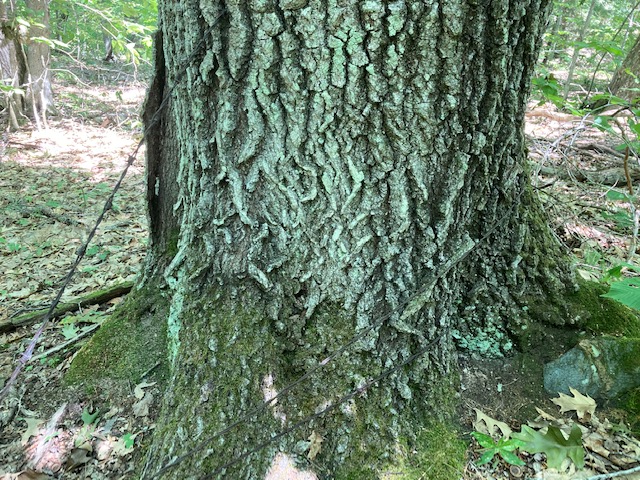
  • As the trail swings R and to the SE, you’ll encounter some much larger trees. Sharp eyes will spot fragments of old barbed wire caught in their trunks and realize these are boundary trees – allowed to grow to such size because neither neighbor dared cut them, and they were serving as useful fence posts at a time when the landscape was more open. One oak looks to be at least 30” in diameter at breast height. 7 minutes from the last fork, the trail swings R again at a huge double-stemmed red oak marked with a red boundary blaze.
  • 3 minutes later, you’re back at the start of Hansy’s Loop. Retrace your steps back down the hill for about 45 paces; just past the fallen tree at R seen earlier, turn L onto a less distinct, unmarked trail.
  • This trail soon reaches a low stone wall, where you turn L and walk gently uphill for a short distance past the end of the wall. This is the first reminder that this wooded land – and most of Hanover – was once open sheep pasture. After all, nobody builds stone walls in the woods! In 1840, Hanover had 2,613 human residents and a startling 11,024 sheep.
  • The trail narrows and rises more steeply to another impressive oak, then flattens out. Soon, arrive at a larger stone wall. Just beyond, a sign announces “Allegra’s Field Trail.”
  • 3 minutes’ hike from the last stone wall, reach another sunny meadow. In your view at about 2 o’clock is Huntington Hill, at 1247’ a perfect twin of the hill you just hiked around.
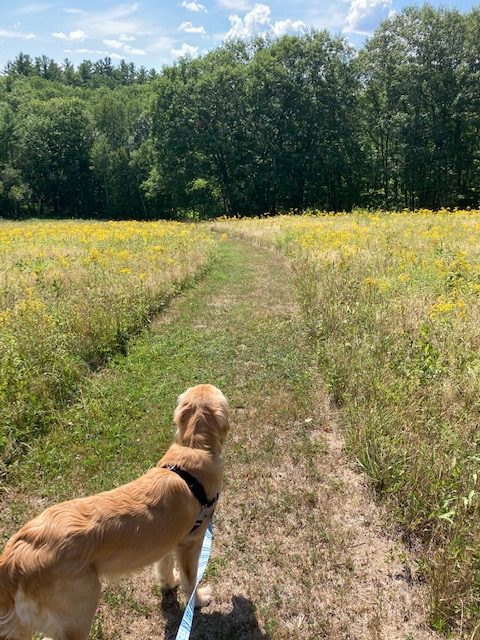
  • The meadow’s mown path forms a T: turn R, noting the lowbush blueberries carpeting the area. This must be a very happy place for bush-surfing bears in July.
  • Head down through the field amid the sunny heads of goldenrod. There are many species of this yellow aster-type flower in northern New England, but did you know that there is also one called silverrod? Its white flowers are reminiscent of moonbeams.
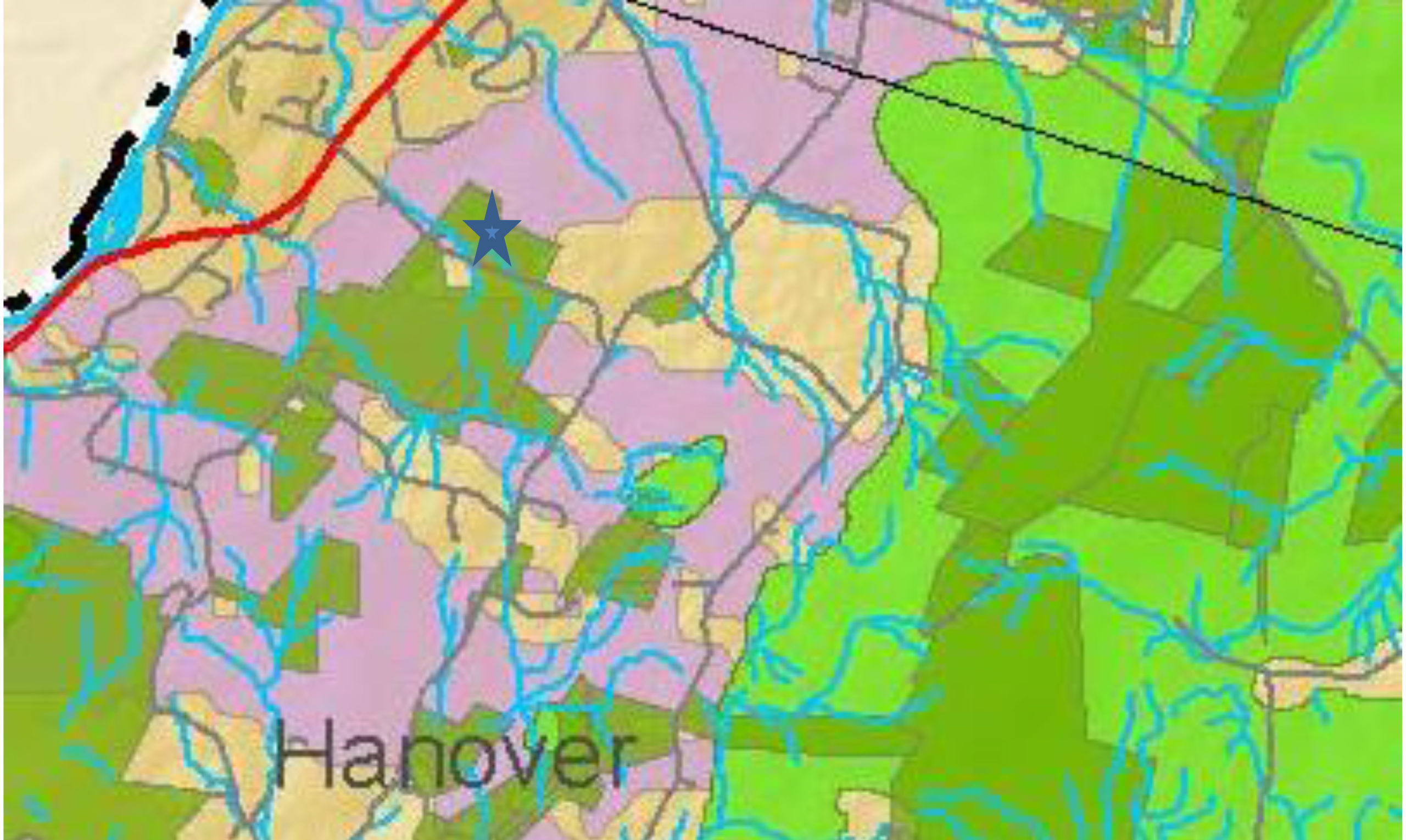
  • Huntington Hill’s variety of habitats – shady diverse forest, sunny meadows, open water, and the edges where they meet – are more important than you might think in keeping Hanover’s landscape resilient to the effects of climate change. Why? Connectivity. Strategically located between the migratory pathway that is the Connecticut River and the uplands of Moose Mountain, Huntington Hill connects these areas. It provides an important travel corridor for birds and other wildlife that need to move around, either seasonally to summer breeding grounds, or more long-term as the climate changes. If wildlife can move freely, their genes can too, meaning that their populations don’t become isolated, inbred, and therefore less healthy. In this map, dark green shows conserved and public lands; light green shows core areas for conservation focus, and purple indicates important connectivity corridors stretching from the river to the core (the star indicates today’s hike location.)
  • As you re-enter the cool woods at the foot of the same stone wall you recently crossed, note the heap of many small stones. These tell you that the land nearby was once tilled, and the farmer went to the effort to pick the stones and transport them here to spare his plow and give his root crops a fighting chance.
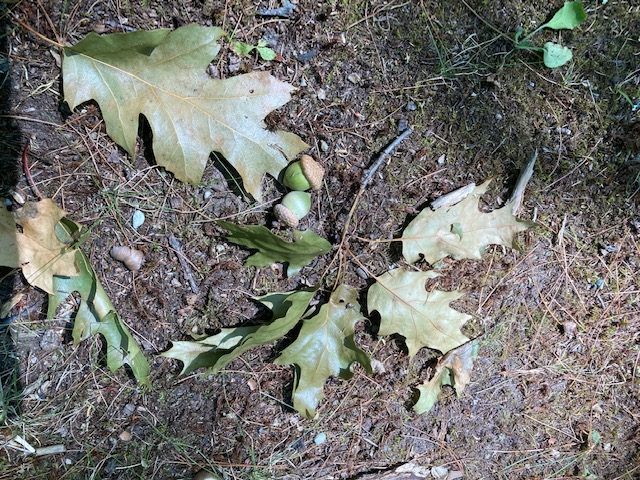
  • Walk along the contour on a wide old farm lane. Watch for acorns on the trail – they make wonderful food for wildlife but can act like ball bearings underfoot!
  • 15 minutes from the top of the last meadow, arrive at the lower end of the first wall you crossed, and Sam’s Pond appears through the trees ahead at L. As you close your second trail loop of the day, note a large rhododendron, oddly out of place near the trail junction. It must have been planted – but by whom, and why?
  • Watch the area carefully before stepping out of the woods. On the day we visited, a male Northern Harrier (formerly called a marsh hawk) sailed out over the meadow from the pond.
  • At the lower field’s edge, turn L to the pond. Pause a moment to watch for wildlife – maybe the darting gymnasts of the air, dragonflies on the hunt above the water’s surface or resting on a blade of grass. Check the sediments at the water’s edge for tracks. Goldfinches chatter in the trees.
  • Continue to the far side of the pond. At this season, your reward may include ripe blackberries on the briars that frame parts of the trail. This is one of many kinds of mast on which wildlife thrives here – blueberries, acorns, naturalized crabapples, and more.
  • Follow the mown path to your car on Goodfellow Road.

Historical Notes

Goodfellow Road, linking Lyme Road with Hanover Center Road since at least 1855, takes its name from the Goodfellow family, from whom Dr. Doyle purchased the land in 1991. The Goodfellows arrived between 1893 and 1925.

In the 1850s-80s several generations of the Runnels family lived on and farmed on the land you visited today. By 1885, John Runnels was listed as a “wool grower” with 125 sheep on 196 acres. He had served three years in the Civil War with the 9th New Hampshire Volunteers.

In the 1880s-90s the Ingalls brothers, A.H. and Charles, occupied the big white farmhouse, barn, and 250 acres across the road. Also sheep farmers, they had an apple orchard of 100 trees, a maple sugar orchard of 200 trees, and 130 head of sheep. Back in 1855, the family of Andrew Huntington – he who gave his name to the property –farmed that land. Andrew, who probably built the 1780 farmhouse, served in the Revolutionary War with his brothers Christopher and Samuel.

Today’s owners feel viscerally attached to their property on Goodfellow Road and were excited to purchase conserved land from Sam Doyle with the promise to Sam that they would continue his focus and dedication to the land – maintaining and expanding the network of trails, promoting the property as a wildlife habitat, keeping fields mowed, and sustainably harvesting timber according to the Forest Management plan maintained by Jeff Smith of Butternut Hollow Forestry.

September, 2020

This Hanover Hike of the Month has been generously sponsored by

Filed Under: Hike of the Month, History, Huntington Hill, September, Trails Tagged With: farming, Goodfellow Road, history, huntington hill, Sotheby's

We’ve got mail!

August 19, 2020

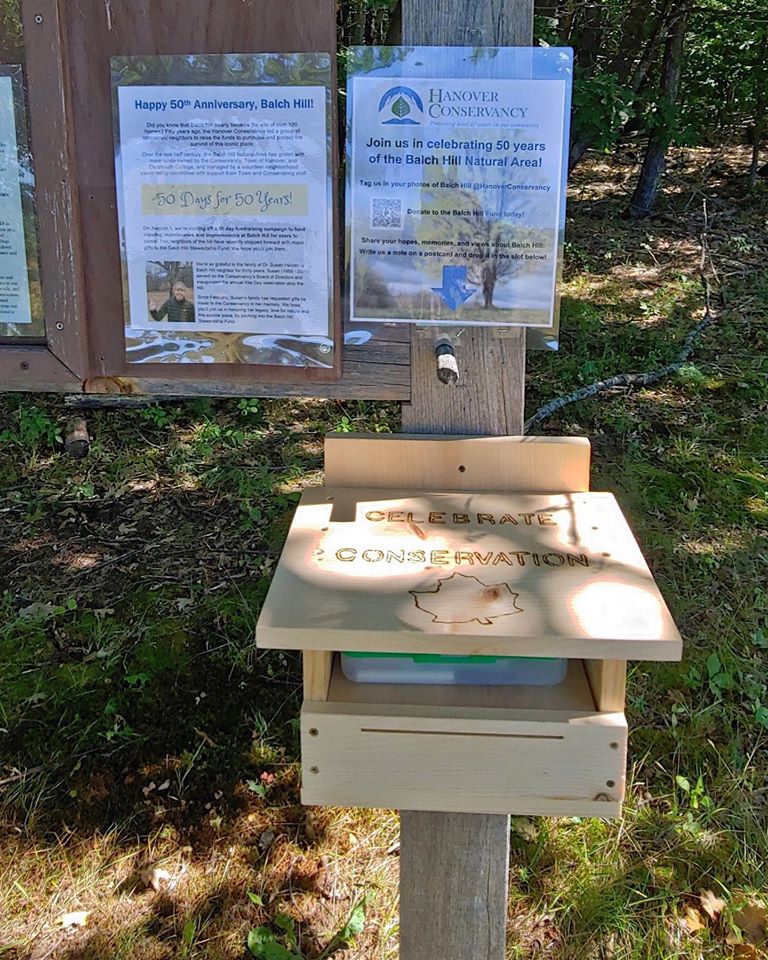
Wooden mailbox on the summit of Balch Hill This fun mailbox on the summit of Balch Hill is filled with pens and postcards so visitors can write a note with their favorite memories of this natural area, whose summit we protected 50 years ago.
Some notes so far: “I am 7 1/2 years old and my Dad brought me here today for the first time! Thank you for keeping this place open. I love the butterflies.”

“This hike is magical. I do it weekly. We are privileged to life in such a beautiful place as this.”

“In honor of Dr. Susan Harper; a mentor and beautiful spirit whose legacy will flourish in the Upper Valley forever.” For more about Susan, visit the News page of our website.

Filed Under: Balch Hill, Conservation Tagged With: Susan Harper

Behemoths of Balch Hill

August 12, 2020

Hike Directions & Map – Full PDF

Driving directions:

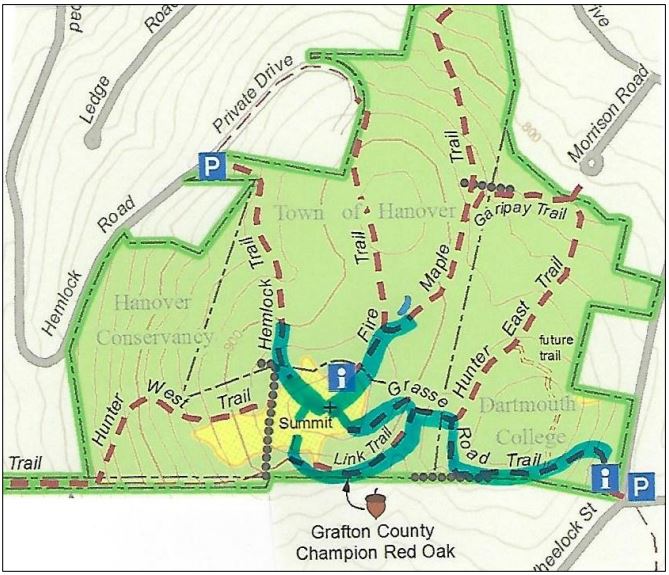
  • From Downtown Hanover, drive east for 1.6Route map on Balch Hillmiles on East Wheelock Street, up a long hill to the junction of Grasse and Trescott Roads.


  • Park in the unpaved informal parking area on the northeast side of this intersection.

What you should know:

  • This loop hike takes you through the Balch Hill Natural Area to the summit with its beautiful views. Along the way you’ll visit grandfather trees that may have witnessed our town’s founding – including the Grafton County Champion Northern Red Oak.
  • You’ll be walking on lands owned by Dartmouth College, the Hanover Conservancy, and the Town of Hanover. Conservation easements and other restrictions protect some but not all of this land.
  • Trails have occasional short up-and-down grades but are easy for the entire family.
  • Foot travel only; no bicycles please.
  • Archery hunting for deer is permitted Sept 15 through Dec. 15; blaze orange is a good wardrobe choice.
  • Dogs are welcome but must be under your control; please pick up after your pet.

BRIEF HIKING DIRECTIONS

  • Take the red-blazed Grasse Road Trail from the trailhead kiosk to the summit, crossing a small footbridge.
  • From the summit kiosk, take the Fire Trail down to the junction with the Maple Trail.
  • Return to the summit and take the Hemlock Trail down to a large fallen tree.
  • Return to the summit and head for a group of apple trees and a stone bench. Look for the Piane Trail sign and turn L onto the red-blazed Grasse Road Loop.
  • Take this trail to the Champion Red Oak; continue to the small footbridge and turn R to return to your car.

FULL DIRECTIONS

  • Begin your hike at the trailhead kiosk, across Grasse Road from the parking area. The Hanover Lions Club generously donated this timber frame kiosk in 2011. Here, you can read a bit about the history of this land and pick up a trail guide if you wish.
  • The Grasse Road Trail heads across the slope on Dartmouth College land. This section was re-routed in 2015 by an Upper Valley Trails crew to follow a gentler, more sustainable path than the original.
  • The path soon turns to avoid a series of downed trees. What happened here? A short but violent windstorm on Patriot’s Day in April, 2007 blew down many trees on this part of the hill, and it will be years before they degrade back into the earth.
  • For several years near this spot stood a deer “exclosure” where Dartmouth ecology students conducted a study  to determine the effect of deer browse on the vegetation. Two identical plots, one fenced against deer and the other unfenced, were compared each year. Here are the results for the plot in this area. The blue bars indicate total number of plants in the fenced plots where deer cannot enter to browse, while red bars indicate the number of plants in the unfenced plots. In 2012, before the fencing went up, both plots had nearly the same number of plants. Contrast that to 2015! The largest change is in the number of wildflowers, especially Canada mayflower.
  • You’ve reached the low stone wall marking the southern boundary. Look for fragments of sheep fencing (large rectangles of wire fence) that date from the pre-Civil War “sheep craze” in the Upper Valley. In 1840, Hanover had over 10,000 sheep grazing on its hillsides, including this one, while the human population was around 2,000.
  • Follow the Grasse Road Trail as it makes a right turn away from the wall and heads north among tall, cool hemlocks.
  • At the junction with the Hunter East Trail (route to the Morrison Road neighborhood), turn left and cross a small log bridge over a wet area and onto Hanover Conservancy land.

Balch Hill sunset in winter. Photo by Rob Chapman

  • The trail bears right then immediately left and heads up the slope past some dramatic pine snags. In ten minutes’ walk from your car, you’ll reach the 920’ summit.
  • Enjoy the sweeping views from this, the only open summit in town where the public is welcome. Twenty-one miles to the south is grand Mount Ascutney. The spire of Baker Tower marks downtown Hanover in the near view to the west, while on the western horizon, 29 miles across Vermont, the sharp peak of Killington appears. To the northwest, our volunteers have been restoring the view toward Gile Mountain in Norwich.
  • Historically, the summit of Balch Hill was used as a pasture for grazing sheep and cattle. Records indicate that it was cleared of most trees for more than a century. In our experience, those trees badly want to return! We’ve been working to restore the orchard on the hill and keep the views open by mowing the meadow.
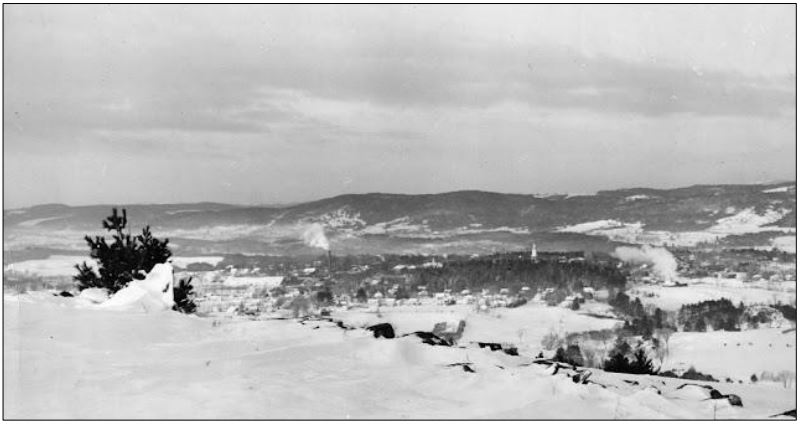
View of Hanover from Balch Hill in winter; undated photo
  • Once known as Corey Hill after an early owner, Balch Hill takes its name from former owner Adna P. Balch (1817-1889). Balch, a prominent citizen who served in the legislature in 1876-1877, promoted the development of the railroad in the Connecticut River Valley and was a director of the Hanover Gas Company. In the early to mid-twentieth century, the summit was known as Dewey Hill Pasture, after owners in those later days.
  • You can imagine what demand there might be to develop this hillside with its astounding views, so close to town. That’s why the Hanover Conservancy, then known as the Hanover Conservation Council, set out to purchase the summit when a New York developer proposed first 126 condominiums and then 49 luxury homes for this place. The community came together to protect the land, with the Council and Town later adding to it with a second purchase from the Garipay family. Make a note to come back for the annual Balch Hill Kite Day in May or the Hawk Watch in September, to see how much the community enjoys this natural area today. It was worth the effort!
  • After visiting the summit kiosk, erected by the Council in memory of Alice Jackson in 2009, begin your tour of Balch Hill’s biggest trees. Take the wide Fire Trail behind the kiosk for a short distance to its junction with the Maple Trail.
  • Take this right turn and in just a few steps you meet some venerable old sugar maples that may once have marked the path of an early road. These ancients stand out against their much younger brethren.
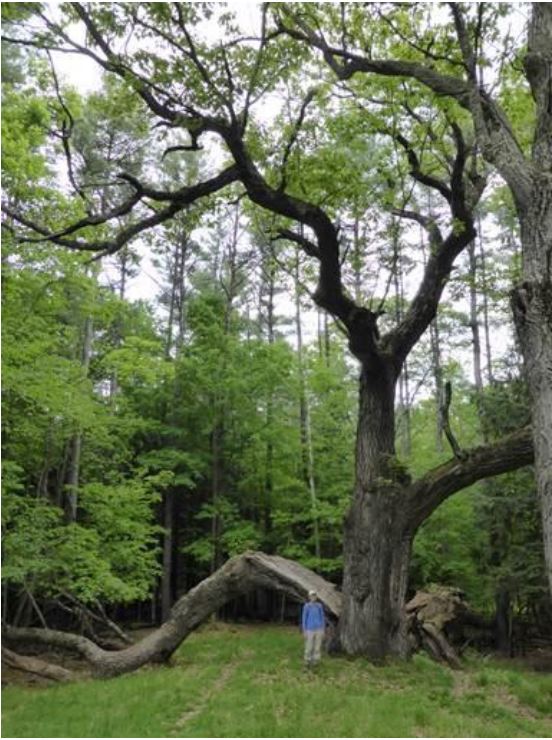
  • A person stands underneath a huge oak tree with one fallen limbHead back up the Maple and Fire Trails to the summit. Pass the kiosk and nearby bench, and head down to the right toward the Hemlock Trail sign. You’ll soon come to the remains of an enormous old oak tree, its split trunk and massive limbs now draped across the landscape, having lost their battle with gravity and time. The trail actually passes under the fallen trunk. Here’s what it looked like in 2014 (right).
  • Return to the summit for your last view before visiting the largest resident of Balch Hill. From the low bench near the summit maple, walk west and downhill toward the view of downtown, to another stone bench near a group of crabapple trees. Just beyond, you’ll see a sign for the Piane and Grasse Rd Loop Trails on the left, nailed to a white birch. Head down this trail only a few steps and make a sharp left onto the red-blazed Grasse Rd Loop.
  • The Grasse Rd Loop trail follows the contour, leading you in a couple of minutes to the County Champion Northern Red Oak, marked with a small sign. Despite its size, it can be easy to miss as its bulk is so far overhead. Look for it opposite the cut trunk of a tree.
  • Neighbors are sometimes reluctant to cut trees along boundaries, and we think it was this instinct that protected this massive tree, the largest survivor of its kind in Grafton County. When measured by the state’s Big Tree Steward in 2014, it had a circumference of 196 inches, a height of 114 feet, and an average crown spread of 80 feet. Had its cousin on the Hemlock Trail not lost its limbs, that tree would have been even larger.
  • After admiring this giant and imagining the history it must have witnessed, continue on the trail that soon bears left to head up a small valley to the small footbridge you crossed earlier. You’re now five minutes from your car.
  • Cross the bridge, bear right at the junction with the Hunter East Trail, and return down the hill to your car.

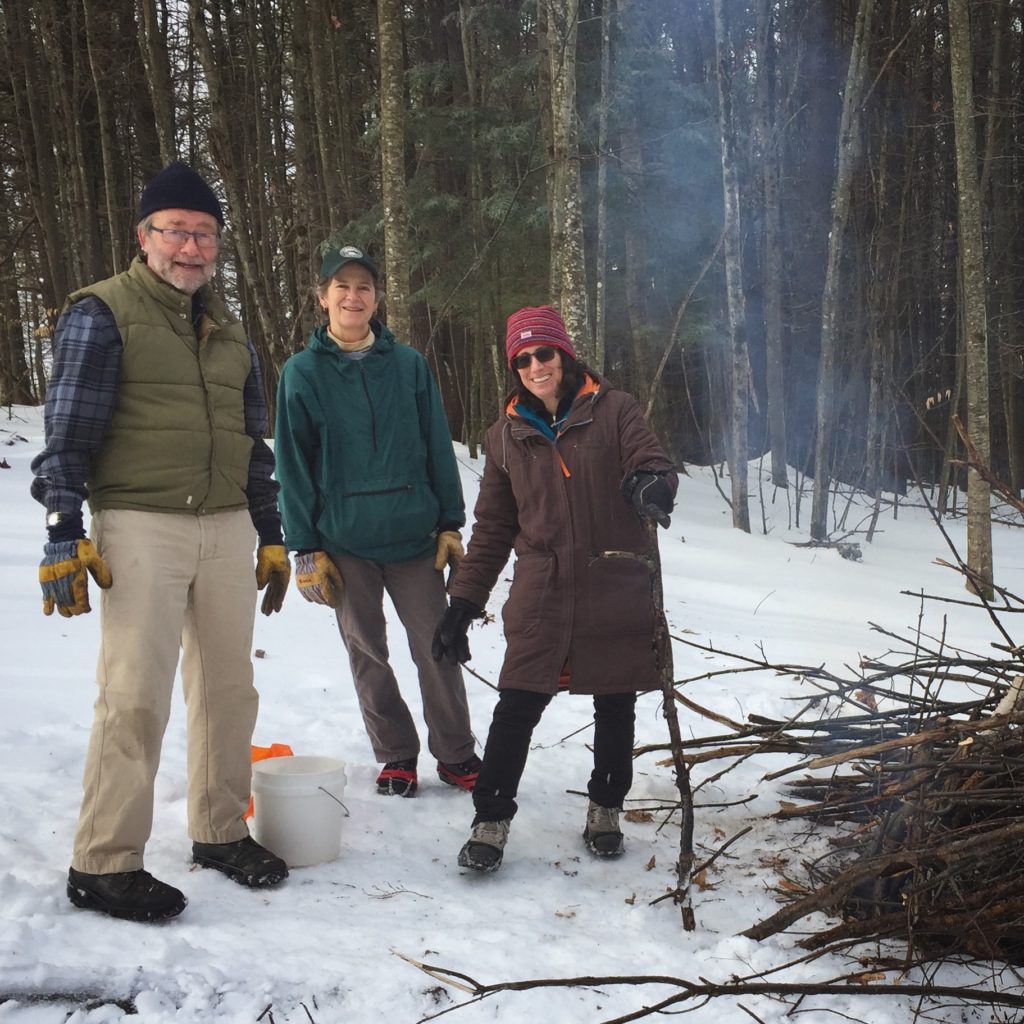
The volunteer Balch Hill Stewardship Committee cares for thisVolunteers tend a fire to remove cut brush on the summit of Balch Hill in winter. place and always welcomes help. Contact us if you’d like to get involved! We welcome contributions to the Balch Hill Stewardship Fund to help with the costs of annual mowing, vegetation management, and trail improvements.
December 2016, updated September 2020

Filed Under: Balch Hill, December, Forest Ecology, Hike of the Month Tagged With: Dartmouth College, history, maple, oak, summit, Town of Hanover, view

General’s Trail

July 15, 2020

HIKE DIRECTIONS & MAP – Full PDF


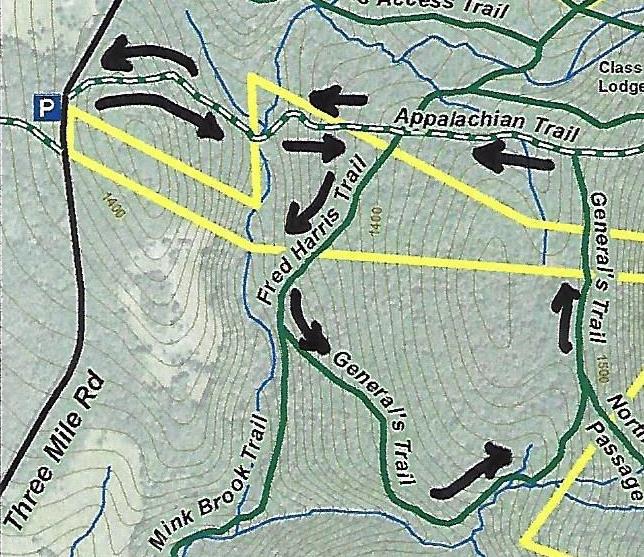
General's Trail route mapDriving Directions

  • From Etna village, turn R onto Ruddsboro Road
  • Follow Mink Brook as the road curves up its narrow valley for 1.5 mi.
  • Turn L onto Three Mile Road
  • After 1.2 miles, arrive at the AT parking area on L, opposite telephone pole 31-50

What You Should Know

  • Foot travel only.
  • Dogs are welcome but must be under close control.
  • Wear blaze orange Sept. 15-Dec. 15 (your four-legged hiking buddy, too!)
  • Hunting is permitted on the AT and other lands you cross at the beginning and end of this hike, but not on the private land crossed by the southern half of the General’s Trail loop.
  • You’ll visit lands owned by the federal government, Dartmouth College, and private owners including the Shumway Forest, protected by the Hanover Conservancy (outlined in yellow above).
  • As of 2021, some trail names are being updated.

Brief Directions

  • Take the AT east from Three Mile Road
  • Turn R onto the Fred Harris Trail
  • Bear L onto the General’s Trail, following uphill
  • Bear L where Northwest Passage comes in at R
  • Turn L onto AT going west
  • Continue straight back to your car at Three Mile Road

Full Hiking Directions

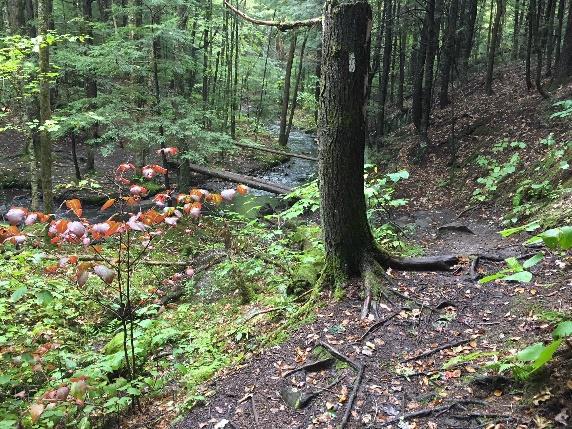
  • tree with white blazeBegin your hike on the Appalachian Trail on the E side of Three Mile Road.  The federal government bought this 21-acre parcel from the Mascoma Beagle Association in the 1980s. It must have been a lively place with the beagles in charge.
  • The white-blazed AT passes over a rise and then gently down into the valley of Mink Brook.
  • Seven minutes into your hike, cross the brook on a log bridge. Nearby, deep purple infuses the fall foliage of a hobblebush, decorating the scene at this time of year.
  • Cross the brook and follow the AT as it climbs back out of the stream valley.
  • Six minutes’ walk from the brook, step over a rotting log and cross onto Dartmouth College land. On this part, the federal government holds a permanent easement to protect the AT.
  • Just after a log crossing at a small wetland, arrive at a 4-way junction. The Harris Trail, former route of the AT, honors the Dartmouth Outing Club’s founder (1909). It offers wonderful skiing when conditions are right. The AT was re-routed off this path onto the ridge of Moose Mountain in the 1980s.
  • At this junction, the AT continues straight ahead – you’ll return down that path to this point. At L, the Harris Trail looks well-traveled. Today, you’re up for the path less taken – turn R. A few yards ahead, a wooden sign reads, “Old Harris Cabin Access.” [new trail name: North Cabin Trail]
  • The wide and grassy trail soon begins to descend gently through northern hardwoods. For the next 5 minutes, you’re traveling through a part of the 313-acre Shumway Forest that was protected by an AT trail easement in the 1980s and in 2017 by the Hanover Conservancy’s more comprehensive conservation easement. Both easements guarantee public access to the trails.
  • Soon a wood sign with arrow directs you L. You have arrived at another parcel of private property. Say a silent thanks to this generous landowner who gamely goes along with the network of hiking trails on Moose Mountain, and take care to leave no trace of your visit.
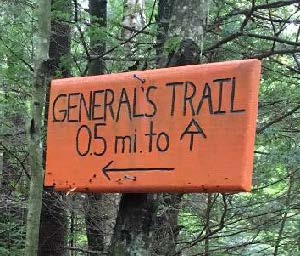
  • General's Trail sign
  • red berries by walking poleShortly after the arrow sign, an orange sign at L marks the W end of the orange-blazed General’s Trail, a pine-needle-strewn path that makes a wide loop back to the AT.
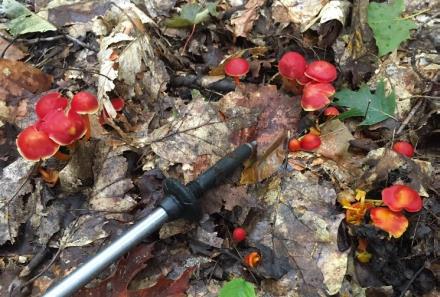
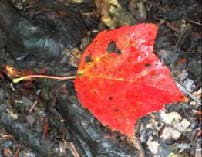
  • In autumn, it seems the whole trail is decked out in orange – from the trail signs and blazes to the brightly colored red eft salamander you might spot at your feet, to the brilliant mushrooms that spangle the forest floor and the fallen leaves of red and sugar maples.
  • red leafThe trail initially has the look of an old woods road but soon narrows, offering gentle and comfortable hiking, unlike the often rooty and rocky AT. This trail was built in the early 1990s by a former owner of this property with the help of his boy scout troop. Why the “General’s Trail?” For a quarter century, it’s been the favorite daily hike of a neighbor who retired from the Air Force Reserve as a two-star general. When his friends and neighbors Peter and Kay Shumway met him often on the trail, they decided to name it for him on their Moose Mountain Lodge trail map. Recently, his daughter asked the Dartmouth Outing Club to make the orange signs as a special birthday gift.
  • Ten minutes from the orange sign, you arrive at an open grove of hemlocks – a good place for a snack. The trail swings L here to follow the rim of a steep valley, but before taking that turn, look over the escarpment to the brook far below.
  • "elbow" birchThe trail turns L past an “elbow tree” at R, a leaning yellow birch that lost its top and headed for the sun.
  • white fungi on log
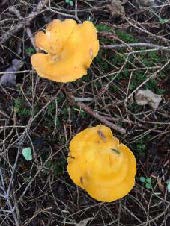
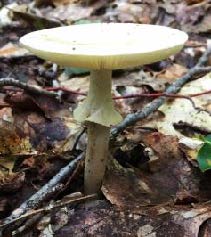
  • Climbing gently up along the stream, the trail soon brings you to an up close and personal look at the tiny Mink Brook tributary. Cross it on impossibly green, luxuriantly mossy logs. You’ll soon encounter a few more “corduroy” log crossings. These places don’t look like much, but they are ecologically valuable. Headwater seeps, kept shaded and forested, serve as an important “sponge” in a downpour and start a stream off on its downhill tumble in the right fashion, cool and clean. Abundant moisture in the forest floor and a rich layer of duff support a fun and fantastic array of fungi.yellow fungi
  • white mushroom
  • The trail reaches the head of the little stream valley and follows the land’s contour as it heads north toward its junction with the AT. As the trail is less distinct here, it’s important to keep an eye out for the orange blazes; stay left at a fork. It’s hard to miss a jumble of pure white boulders of quartz.
  • yellow fungi by leaves20 minutes from the hemlock grove, a vertical white “US AT Boundary” sign appears on a white birch at L, and you know you’re getting close.
  • Three minutes later, arrive at the AT; note the orange “General’s Trail” sign.
  • Turn L and follow the famous path as it heads gently and pleasantly downhill.
  • What a difference thousands of feet per year can make! The AT treadway is well-worn but also well-loved, evidenced by some clever bits of trail work that carry the path over small drainages.
  • Five minutes after bidding the General goodbye, you return to the familiar four-way intersection with the Harris Trail. Cross it and continue straight on the AT.
  • Seven minutes from the intersection, the brook and bridge come into view. If you didn’t stop for a picnic at the hemlock grove, this is a great picnic spot too.
  • These waters and the rest of the Mink Brook watershed were part of a statewide study by Trout Unlimited and NH Fish and Game biologists in 2011. They found that “Hanover’s little Mink Brook and its tributaries showed a surprisingly healthy population of native Eastern Brook Trout.” They counted 213 brookies in 16 study sites and noted how important cold clean water is for this species. Almost 70% of the trout were found in five sites (including this one) with an average water temperature of 59.8 degrees. If you have such a stream on your property, what can you do to help brook trout? Keep a lush buffer of trees and shrubs to shield it from the summer sun.
  • Cross the bridge with its handrail and head back up and out the seven minutes’ hike to your car.

Please respect the generosity of these landowners by leaving no trace of your visit and enjoy the memories and photographs you take home.

9/2018, revised 1/2021


Filed Under: Hike of the Month, Moose Mountain, October, Shumway Forest Tagged With: Appalachian Trail

Hanover Votes to Fund Mink Brook Community Forest

July 8, 2020

At last night’s Hanover Town Meeting, residents voted to approve a $500,000 contribution towards the purchase of the Mink Brook Community Forest from reserve and conservation funds held by the Town. From the Valley News, “Plans to turn 260 acres of woods and old farmland along both sides of Greensboro Road into a town forest also were OK’d on Tuesday. Residents voted by a show of hands to spend $500,000 to help purchase land which crosses Mink Brook and includes a brick farmhouse from 1850. The Trust for Public Land, assisted by the Hanover Conservancy, hopes to spend $2.5 million acquiring the property from the Leavitt family. So far, an anonymous donor has footed $500,000 to help the project, which also received a $600,000 community forest program grant from the U.S. Forest Service. None of the town’s share will come from new taxes, and will instead be taken from existing reserve and conservation funds. Officials also hope to sell the property’s farmhouse to help finance the overall project, and a separate four acres could be used by Twin Pines Housing Trust to build “a small cluster of affordable cottage-style homes targeted to new homeowners,” according to an April news release.” 

Filed Under: Conservation, Media, Mink Brook Community Forest, Partnerships

  • « Previous Page
  • 1
  • …
  • 4
  • 5
  • 6
  • 7
  • 8
  • …
  • 29
  • Next Page »

71 Lyme Road
Hanover, NH 03755
(603) 643-3433

info@hanoverconservancy.org

Facebook logo   Instagram   YouTube

Get Involved

Become a Member

Volunteer

Business Sponsors

Conserve Your Land

Employment

Our Mission

Advocacy

Conservation

Education

Stewardship

Explore Hanover

Hanover Hikes

Upcoming Events

Upper Valley Hikes

Trails Challenge

Copyright © 2026 Hanover Conservancy | Design by Chase Brook Software